
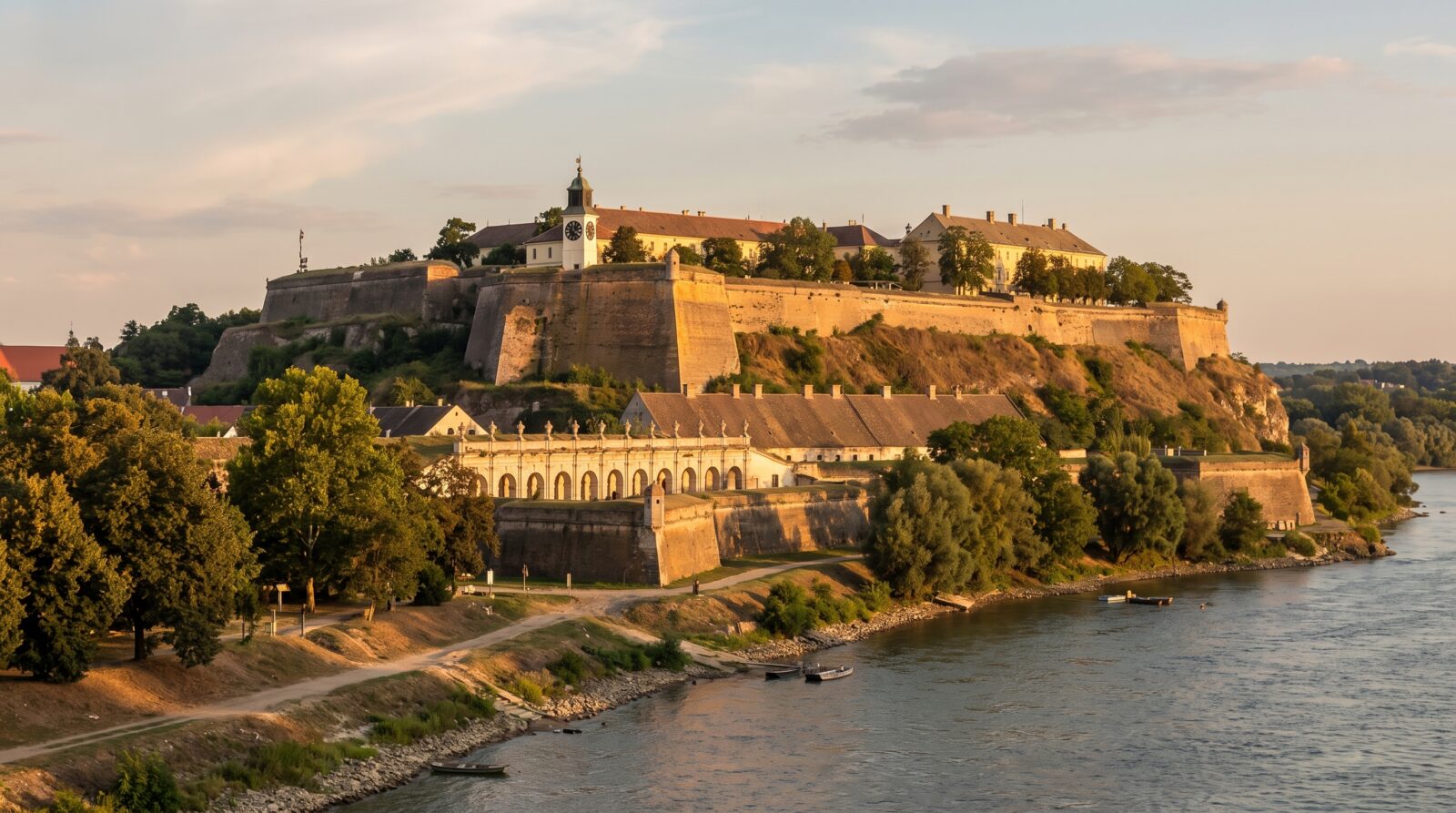
Petrovaradin is what turns a Novi Sad day trip into more than a change of scenery. The fortress stands directly across the Danube from the old town, close enough to walk the whole loop once you’re across the river, and the fast train from Belgrade covers the distance in well under an hour. Trains leave from Beograd Centar, also signed as Prokop since the older main station stopped taking trains; ignore a map or an old guidebook that sends you toward the historic station building.
A day here usually starts at the fortress, with its ramparts, its clock tower running with the hands reversed, and the tunnels dug beneath it. It then crosses into the old town for Liberty Square, the cathedral that anchors it, and a choice between two very different museums. None of it needs a car, and nothing on this route needs booking days ahead.
What this page will not give you is a departure time. Both the train operator and the Belgrade bus station publish a live search tool for their schedules, and nothing static to print. Treat the journey lengths below as journey lengths, not as a clock you can plan the whole day around. Check the actual departure the day before you travel.
The short version. The fast train from Beograd Centar reaches Novi Sad station in 36 minutes, or Petrovaradin station in 34. The operator publishes a timetable for the line as a PDF, valid until December 2026, but we do not repeat departure times from it, so read it yourself or run the live search before you go. Petrovaradin Fortress carries no stated entrance fee, though the City Museum inside it (09:00-17:00, closed Monday) and the guided underground galleries are ticketed separately, at prices neither publishes online. The Gallery of Matica Srpska has reliably current 2025 prices; the Museum of Vojvodina’s own price page still dates to 2013. If your train ends at Petrovaradin rather than Novi Sad station, a free shuttle bus covers the last stretch into the centre.
On this page
Getting there, and checking the time yourself
The train has a published timetable; the bus does not. Here is what is actually established for each, and how to check the part we will not repeat.
Taking the train in well under an hour
Srbijavoz runs a high-speed double-decker service, the SOKO, on the line north from Belgrade. The operator’s own page states the journey takes 36 minutes to Novi Sad station and 34 minutes to Petrovaradin station, on the opposite bank of the river. Both are fixed characteristics of the line rather than figures that vary train to train, so the duration holds whichever departure you take.
That page gives no clock time, only journey durations and season-ticket prices; the actual departures live behind a live search tool at a different address, w3.srbvoz.rs, where you enter your date and stations. That address belongs to the same state operator as srbijavoz.rs, under a related domain used for ticketing and timetables, so do not mistake the switch for a scam.
Belgrade to Novi Sad goes further into the stations and the fares; use the search tool itself, or the operator’s line on 011 360 28 99, to pin down your actual train.
Check, before you book, whether your specific train ends at Novi Sad station itself or at Petrovaradin across the river. The two stations are not the same place, and which one you land at changes your first ten minutes in town.
Taking the bus as a station-free alternative
A bus service between Belgrade and Novi Sad exists, but Belgrade’s own bus station gives you nothing to plan from in advance. Its official site publishes no static route page for this journey, only a from-to-date search form, and the site itself states only the station’s address, phone number and opening hours.
No duration, frequency or fare could be confirmed from an official source, and Novi Sad’s own bus station operator could not be identified from one either. Treat the bus as a real alternative, not a myth, but run the search on the day rather than expecting a fixed schedule.
Getting back the same night
We do not give you a last train time, and here is why. It is the single most useful thing on a day trip, so the omission is deliberate rather than lazy. The operator does publish a timetable, a PDF covering Beograd centar to Petrovaradin and Subotica, dated June 2026 and valid until 12 December 2026, at https://www.srbvoz.rs/red-voznje-kurir/bgcent_ns_su.pdf. It is a dense multi-column table, and every attempt to read a departure out of it here misaligned trains against times. A wrong last train is worse than none: it leaves you on a platform. Read the PDF yourself, or run the live search on the day, and treat the return as the thing you fix first.
Do not assume a late evening train back to Belgrade exists just because the outbound one did. Check the search tool or call 011 360 28 99 before committing to a full day, and build in enough margin that a shorter-than-hoped train schedule does not leave you stranded.
The bus is a different case: the coach station publishes no static timetable at all, only a search form, so it cannot be planned around sight unseen in either direction.
Moving between the station, the fortress and the centre
If your train ends at Petrovaradin station rather than at Novi Sad itself, a free shuttle bus covers the gap. It runs between Petrovaradin station and the Uspenska/Safarikova stop in central Novi Sad, taking about 20 minutes one way, roughly every 20 to 40 minutes from around 04:00 to past midnight.
The operator ties it explicitly to ongoing infrastructure works that its own notices say run through 31 December 2026. That makes it a current arrangement rather than a permanent service, so check it is still posted on the day you travel.
Once you are in Novi Sad, do not carry over an assumption from Belgrade. Getting around Belgrade covers a city where regular public transport has carried no fare since January 2025; Novi Sad is a different city with a different rule.
A single fare here runs 65 dinars with the local NSmart card, or 100 dinars paid to the driver. Children aged 6 to 10 pay a reduced 38 dinars, travel is free under 6, and a day ticket costs 278 dinars. Petrovaradin and the nearby town of Sremska Kamenica sit in the same fare band as central Novi Sad. Given how compact the centre and the fortress both are, walking covers most of a single day regardless.
Walking Petrovaradin Fortress
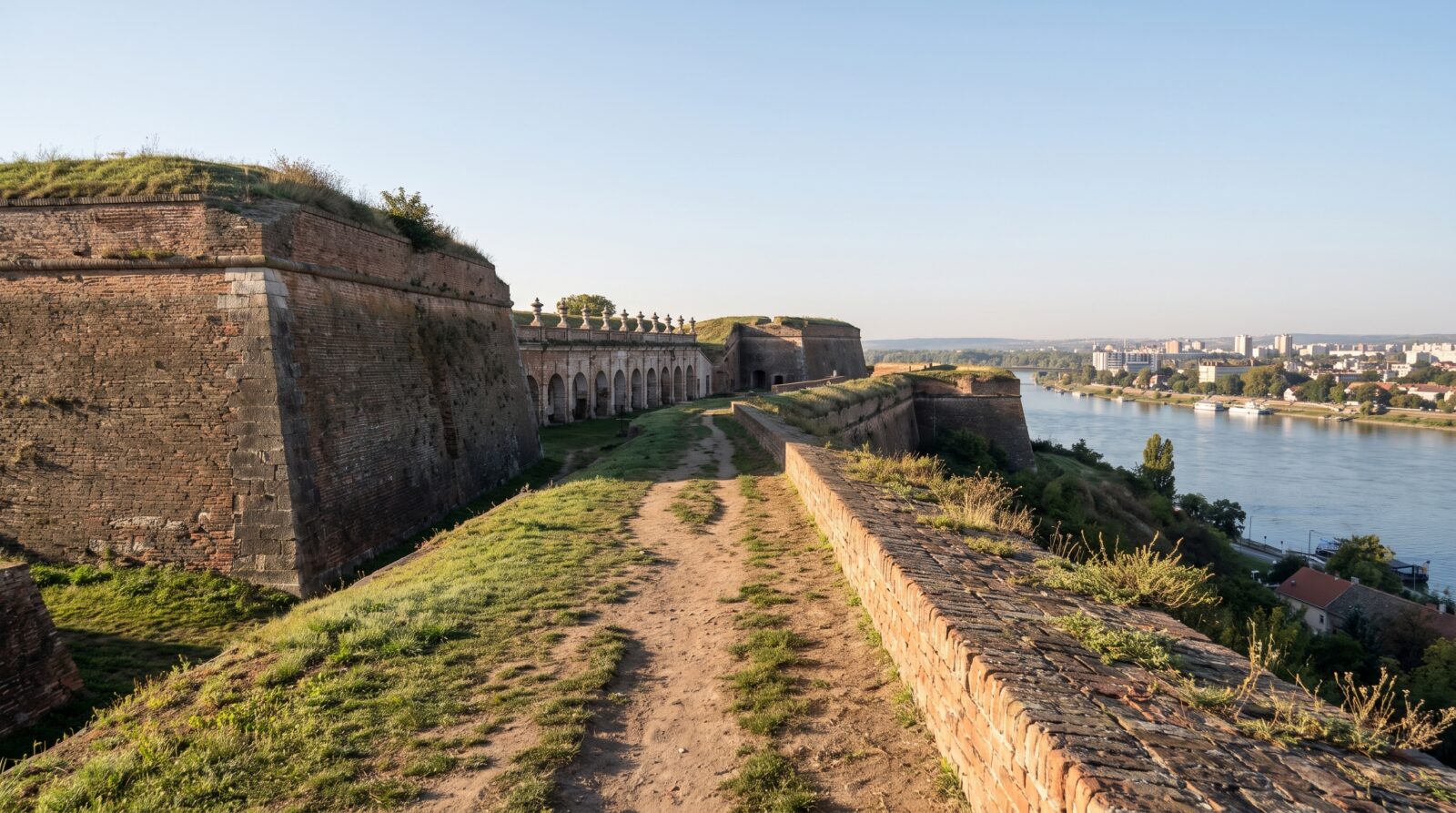
The Austrian Empire built Petrovaradin after taking the site from the Ottomans in 1691, laying the foundation stone the following year and finishing the main construction by 1780. The result, nicknamed the Gibraltar on the Danube, covers 112 acres split between an upper and a lower town. Its ramparts are the reason the fortress reads as a district of Novi Sad rather than a single monument you tick off in ten minutes.
Walking the grounds appears to cost nothing, though no page says so outright. None of the official pages describing the fortress, whether the overview, the architecture page or the tourist office’s own listings, mention an entrance fee for the bastions, gates or open ground.
The complex reads throughout as an open part of the city, with only the City Museum inside it and the guided gallery tours priced separately. Treat that as a reasonable expectation rather than a confirmed policy, since it rests on what the sources do not say rather than on a stated free-entry line.
Reading the reversed clock hands
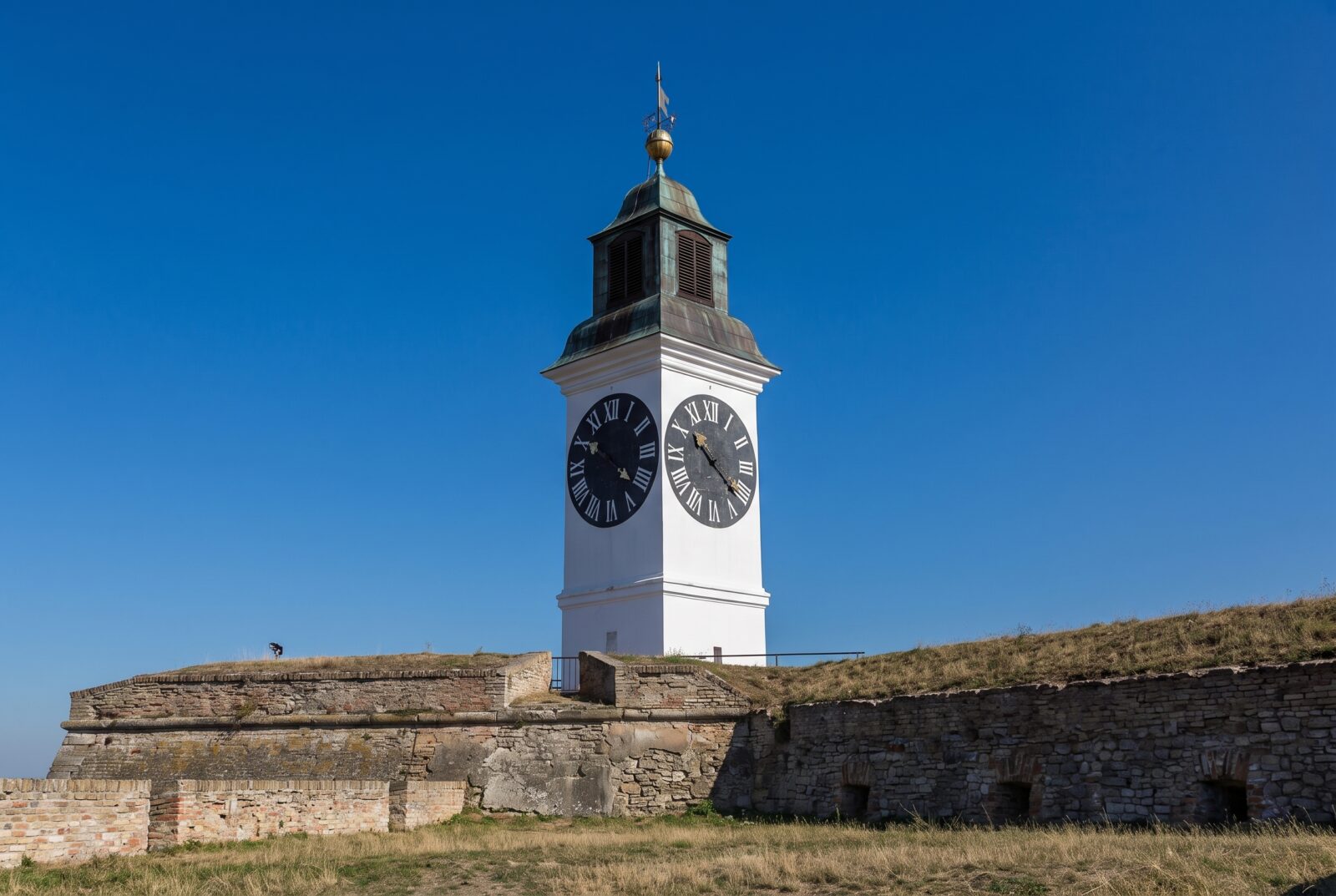
The clock tower is the fortress’s most photographed feature, and the reason has nothing to do with its size. Its face is over two metres across, set on all four sides of the tower with Roman numerals. The hands work backwards from any other clock you have read: the large hand marks the hour, the small one the minute.
The tourist office’s own account says this was deliberate, done so the time could be read from a greater distance, which mattered when the tower’s main audience was boats on the river below rather than pedestrians beside it. Locals call it the Drunken Clock, because temperature changes affect the mechanism enough to speed it up or slow it down, and it is wound by hand every day.
Going underground in the tunnels
Beneath the ramparts run 16 kilometres of military galleries across four levels, of which about one kilometre is open to visitors. You will see other lengths quoted elsewhere online; the museum’s own page is the more recently maintained of the sources checked for this page, so it is the one used here.
The galleries are visited only through the City Museum’s guide service, arranged by phone on 021 6433 145. The operator describes organised visits rather than a walk-through open to casual visitors, and does not state whether an individual can join a tour without booking ahead, so call before you build a visit around them.
Deciding whether the City Museum is worth the stop
The City Museum of Novi Sad occupies the Topovnjaca building at Tvrdjava 4, inside the fortress. It closes on Mondays and otherwise opens 09:00 to 17:00, holding three permanent exhibitions and more than 50,000 objects across its branches.
Entry is free for ICOM and museum-association members, for unaccompanied children, and for visitors with disabilities. No admission price for a general adult ticket is published anywhere on the museum’s own site, on a page whose own title refers to tickets. This page cannot give a figure, so ask at the entrance or call ahead if the price will decide whether you go in.
Crossing into the old town centre
Liberty Square, Trg Slobode, has been the centre of Novi Sad since the first half of the 18th century, sitting at the end of Zmaj Jovina street. Its two defining buildings face each other across the square: the neo-Renaissance City Hall, completed in 1894, and the Roman Catholic Parish Church of the Name of Mary, finished the following year. The city’s tourist information centre sits on the same square, at Trg Slobode 3.
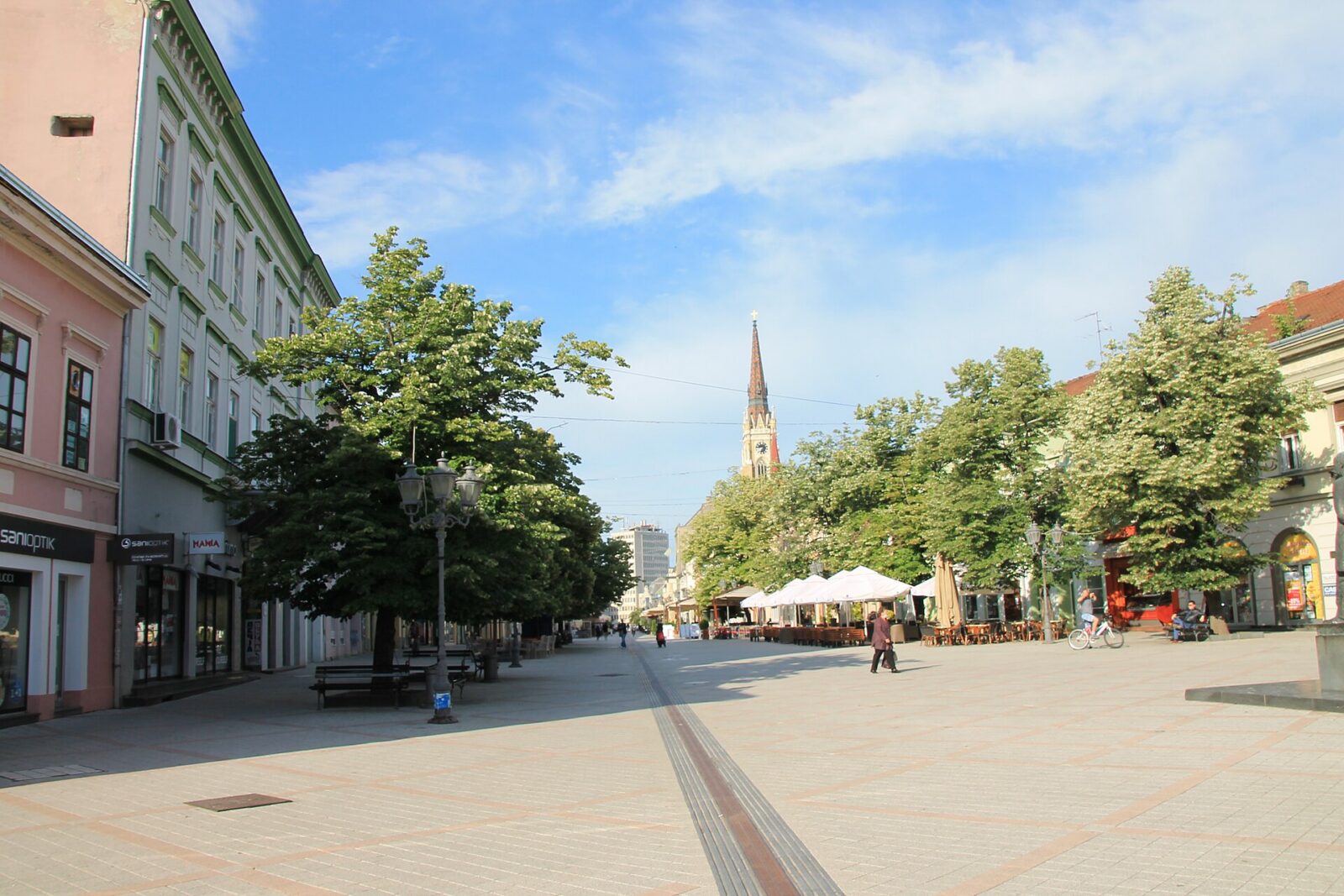
The church on Liberty Square is neo-Gothic, designed by Gyorgy Molnar, built between 1893 and 1895, and its tower reaches 73 metres, the tallest place of worship in Novi Sad. Guides sometimes call it simply “the cathedral,” which can send you looking in the wrong direction: a separate, larger Serbian Orthodox Cathedral Church of St George stands near the Bishop’s Palace elsewhere in the centre. If someone mentions the cathedral without naming it, ask which one they mean before you walk off.
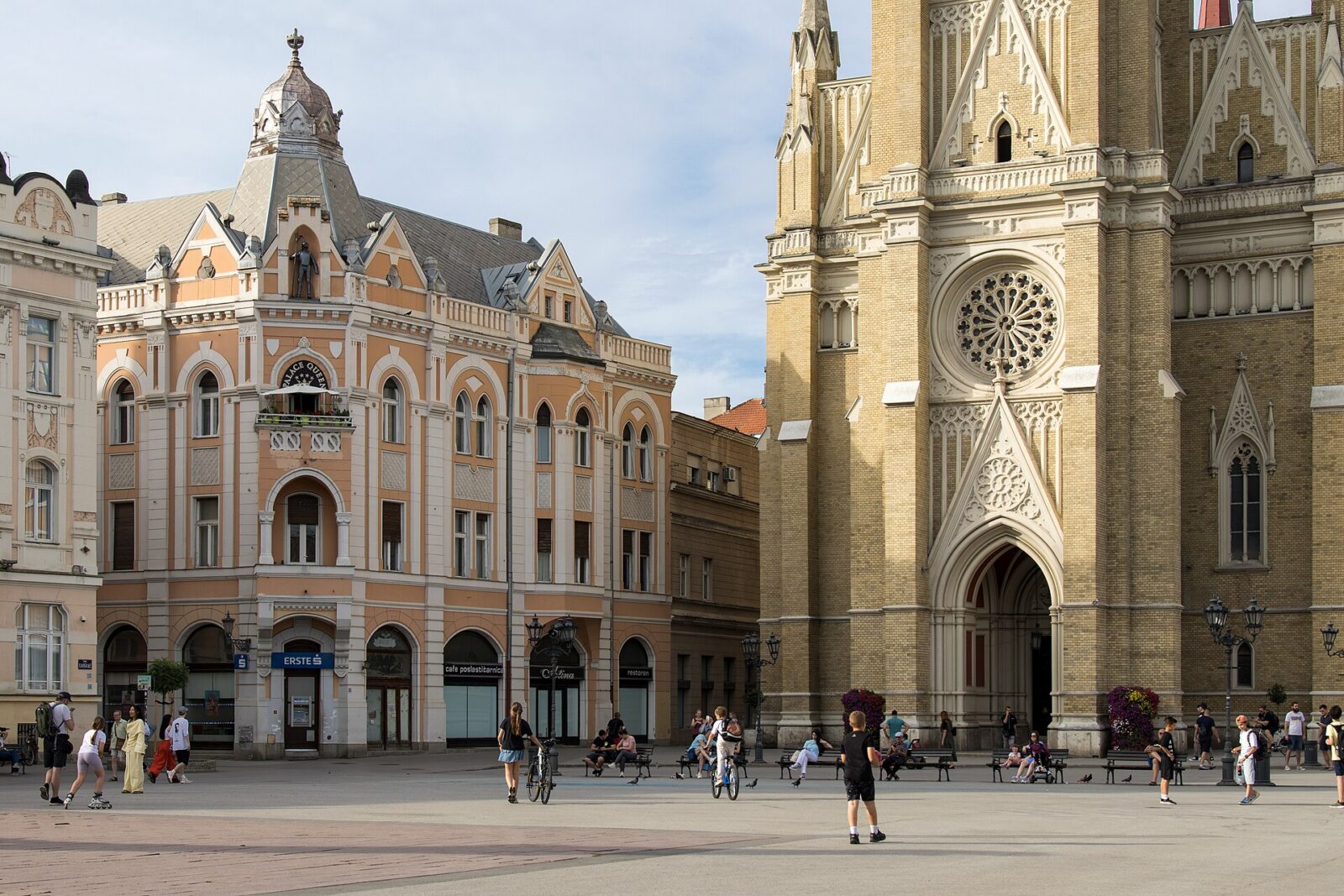
The tourist office on the square keeps working-day hours of 08:00 to 21:00 and Saturday hours of 09:00 to 17:00. Its own page says nothing about Sunday, so treat Sunday opening as unknown rather than assume it is either open or closed; call ahead on +381 21 66 17 344 if you are relying on it.
Choosing between the two museums in town
Two museums sit within a few minutes’ walk of Liberty Square, and they suit different interests rather than competing for the same visit.
The Museum of Vojvodina, the region’s largest museum institution and more than 150 years old, sits at Dunavska 35-37, covering archaeology, ethnology and history. A single ticket covers three sites: the two Dunavska addresses and the Museum of Unification. It opens Tuesday to Friday from 09:00 to 19:00 and Saturday to Sunday from 10:00 to 18:00, closed Mondays.
The Gallery of Matica Srpska, at Trg Galerija 1, holds the richest collection of Serbian art from the 18th and 19th centuries. It opens Tuesday to Thursday from 10:00 to 20:00, Friday from 10:00 to 22:00, and Saturday to Sunday from 10:00 to 18:00, also closed Mondays, with last admission 30 minutes before closing.
| Museum | Closed | Regular price | Worth knowing |
|---|---|---|---|
| Museum of Vojvodina | Monday | 300 RSD, on a price page dated 2013 | Confirm by phone, 021 525 059, before relying on this figure |
| Gallery of Matica Srpska | Monday | 400 RSD, on a page dated March 2025 | Free on Fridays for individual visitors |
The Museum of Vojvodina’s price is the least trustworthy figure on this page. Its ticket-prices page is the only page on the museum’s entire site still carrying a 2013 modification date, against 2024 for the museum’s opening hours and homepage.
It states 300 dinars regular, 200 for students and over-60s, 500 for a family of three or more, and free entry on Thursdays for pensioners and for archaeology, history and art-history students and professors. None of that can be treated as current pricing; call 021 525 059 or check on arrival rather than budgeting against these numbers.
The Gallery of Matica Srpska’s own prices, by contrast, come from a page updated in March 2025: 400 dinars regular, 200 dinars discounted for students and over-60s, 800 dinars for a family of three or more, and 1,200 dinars for an individual guided tour. Entry is free every Friday for individual visitors and free on Tuesdays for parents accompanied by babies. If price certainty matters more than collection size, that recency makes the gallery the safer bet of the two.
Don’t plan the day around EXIT
If a Novi Sad day trip is on your list because of EXIT festival, check the calendar before you build anything around it. The organiser announced in October 2025 that the festival would move to an international tour rather than return to Petrovaradin in 2026, after a final edition at the fortress in July 2025.
The only Serbian date announced for 2026 is a different event, No Sleep Festival, held in Belgrade in November, which has nothing to do with Novi Sad. A day trip built around Petrovaradin still makes sense on its own terms; just do not expect the festival to be part of it.
Common questions
Can I do Novi Sad as a day trip without a car?
Yes. The fast train covers the distance in well under an hour, and the fortress and the old town both sit within walking distance of either train station once you arrive. A car adds nothing this route needs.
Is Petrovaradin Fortress free to enter?
No official page states an entrance fee for walking the fortress grounds, and none of the sources checked for this page mention one. That is an absence rather than a confirmed free-entry policy, so treat it as likely rather than guaranteed. The City Museum inside the fortress and the guided underground galleries are ticketed separately, though neither publishes its price online.
What happens if my train ends at Petrovaradin instead of Novi Sad station?
You are not stranded. A free shuttle bus connects Petrovaradin station to the Uspenska/Safarikova stop in central Novi Sad, taking about 20 minutes and running roughly every 20 to 40 minutes for most of the day. The regular city bus covers the same route if you would rather use that instead.
Can I visit Novi Sad during EXIT festival?
Not at Petrovaradin in 2026. The festival announced a move to an international tour rather than a Novi Sad edition this year, so a day trip planned around the fortress will not coincide with it. Check the organiser’s own announcements before assuming otherwise.
Do I need to book the underground galleries in advance?
The museum does not say. Visits run through its guide service only, arranged by phone on 021 6433 145, and the museum describes organised tours rather than a walk-through, but it never states whether an individual can turn up and join one without booking. Calling ahead is the safer move if seeing the tunnels matters to your day.
Which museum should I pick if I only have time for one?
If pricing certainty matters, the Gallery of Matica Srpska publishes current figures from 2025, while the Museum of Vojvodina’s only price page dates to 2013. If collection size and scope matter more, the Museum of Vojvodina is the larger institution and covers archaeology, ethnology and history across three linked sites on one ticket.
Nearby
Belgrade to Novi Sad covers the stations, the stops in between and the fare detail this page only summarises. If a single day feels short, Sremski Karlovci is a short ride further along the same road and adds a wine-town stop, and Fruska Gora extends the trip into the national park’s monasteries and hiking routes.
Getting around Belgrade explains the free-transport rule that stops working the moment you cross into Novi Sad, and day trips from Belgrade lists the other routes that work on the same pattern.