
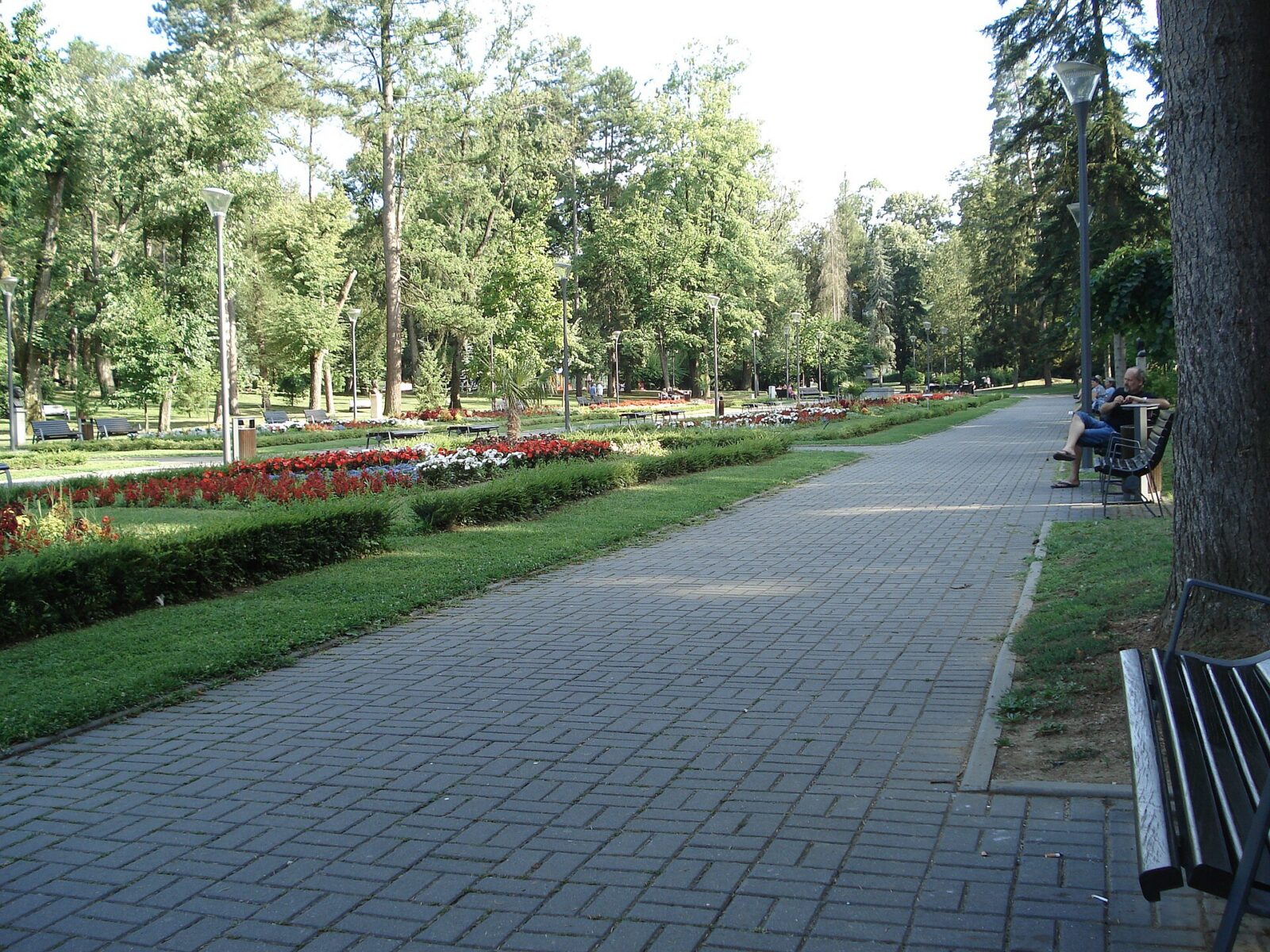
Vrnjacka Banja runs on water rather than on a single monument, and that changes how you plan a visit. Banja is simply the Serbian word for a spa or a bath, and Vrnjacka identifies which one this is. The town’s mineral springs feed a treating hospital, a resort’s pools and a public park, and most people come here for a course of treatment or a few quiet days rather than for sightseeing in the usual sense.
That also changes the questions worth asking before you go. There’s no single gate and no single ticket. The hospital and the resort that run the springs publish some prices and hours in detail and leave others out entirely, sometimes on the very same site, and this page reports both rather than guessing at the gaps.
None of that makes the springs themselves any less real. Four of them are named and classified in enough chemical detail that you could take the numbers to a hydrologist, and a working hospital has built its treatment programme around them since long before either of its neighbouring spa towns had a comparable one. The uncertainty here is administrative, not medical.
The short version. The tourist office names four mineral springs still used for treatment, from an alkaline homeotherm at 36.5 degrees Celsius to a cooler acrotopeg at 14 degrees Celsius. Entry to the resort’s thermal pool, the Aqua centar, is 1,000 RSD, sold as an add-on for hotel guests rather than a public day ticket. A second pool, the wellness centre, is priced at two different figures on the operator’s own site, 900 RSD and 1,500 RSD, and neither page explains the gap. No opening hours are published for either pool, and the town sits 190 km from Belgrade’s Nikola Tesla Airport.
On this page
What the springs are known for
Vrnjacka Banja’s tourist office describes four of its mineral springs as still used therapeutically, each at a different temperature and mineral balance. Topla voda is the oldest and best known, an alkaline carbonic-acid homeotherm at 36.5 degrees Celsius. Sneznik runs cooler, an alkaline-alkaline-earth carbonic-acid acrotopeg at 17 degrees Celsius. Slatina is cooler again, at 14 degrees Celsius, with the same alkaline, alkaline-earth, carbonic-acid classification. Jezero sits in between, an alkaline-alkaline-earth carbonic-acid hypotherm at 27 degrees Celsius.
| Spring | Temperature | Classification |
|---|---|---|
| Topla voda | 36.5 degrees Celsius | Alkaline carbonic-acid homeotherm |
| Sneznik | 17 degrees Celsius | Alkaline-alkaline-earth carbonic-acid acrotopeg |
| Slatina | 14 degrees Celsius | Alkaline, alkaline-earth, carbonic-acid acrotopeg |
| Jezero | 27 degrees Celsius | Alkaline-alkaline-earth carbonic-acid hypotherm |
The classifications sound technical because they are: a homeotherm is roughly body temperature, a hypotherm runs below it, and an acrotopeg is simply a cold mineral spring, precise enough that a hydrologist could use the figures directly. In practice the labels mostly explain which spring a treatment programme is likely to use and why, hot water for soaking, cooler water for drinking cures, rather than which one is somehow the best.
Three more springs appear on the same tourist office listing, Beli Izvor, Borjak and Vrnjacko Vrelo, named but not described as being used for anything today. If you’re wondering whether to seek them out, the tourist office gives you no reason to and no reason not to. It simply doesn’t say. The gap between named and described matters if you’re trying to work out what’s worth building a stay around: only the four springs above are tied to any documented use, and it’s those four the hospital’s own treatment programme draws on.
What the hospital says the water treats
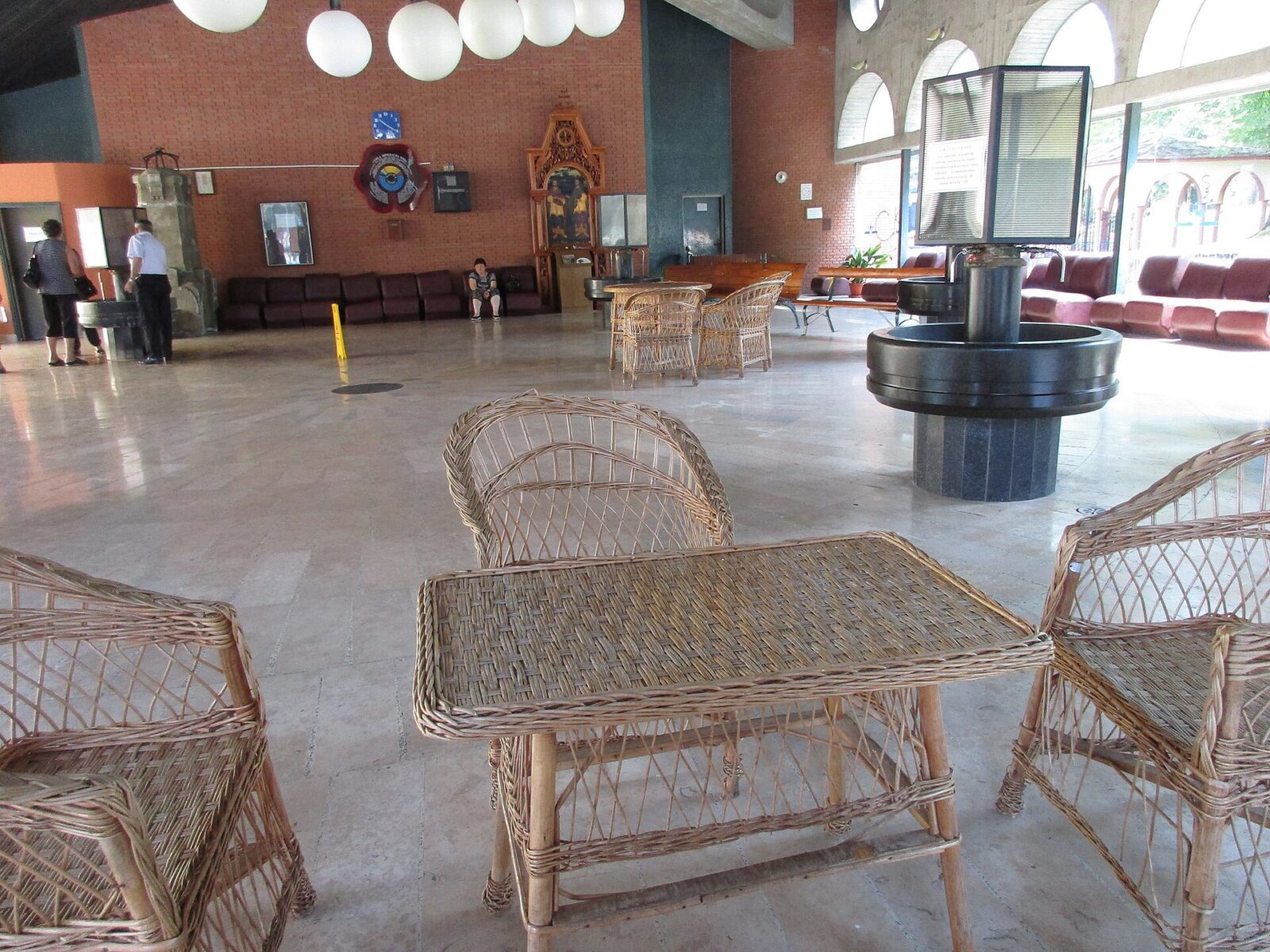
The Special Hospital Merkur, which runs the town’s treatment programmes, describes its use of the mineral water under what it calls a centuries-old tradition. Its own medical page groups the claims into three broad areas. The first is diabetes, both type 1 and type 2. The second is a long list of digestive conditions: gastric and duodenal ulcers, reflux disease, hiatal hernia, chronic gastritis and duodenitis, post-surgical states of the stomach, duodenum, colon or gallbladder, and inflammatory or functional bowel disease, including irritable bowel syndrome.
The third area is physical medicine: degenerative disease of the spine and joints, rehabilitation after orthopaedic surgery, inflammatory rheumatism in a quiet phase, extra-articular rheumatism, gout in remission, osteoporosis, spinal and limb deformities, peripheral nerve damage, vascular disease at stage I or II, recovery after a stroke, and recovery after surgery on the brain or spinal cord for benign conditions. A separate paragraph on the same page adds gynaecological and urological indications, among them infertility, polycystic ovaries and recurrent pelvic infections.
These are the hospital’s own claims about its own programmes, stated on its own site, not an independent assessment of what the water does. Several conditions are qualified rather than stated outright, rheumatism only in a quiet phase, vascular disease only at an early stage, gout only in remission, and it’s worth keeping those qualifiers in mind rather than reading the list as a blanket cure for anything on it.
What you’ll pay to use the pools
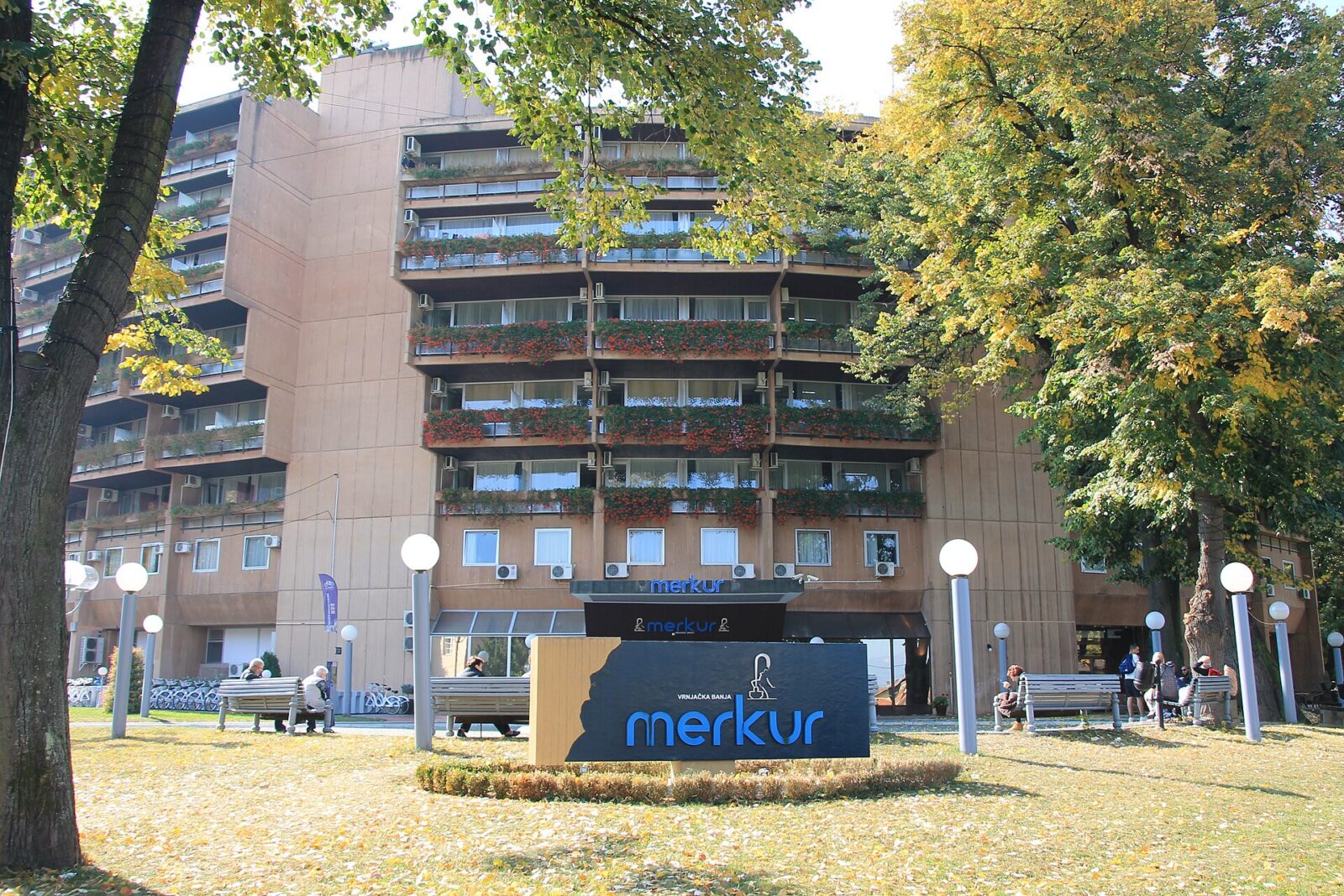
Merkur is also where the hospital and the resort’s pools share a name, and it turns out a website: the same domain that lists the medical programmes above also sells access to two recreational facilities, the Aqua centar “Waterfall” and a separate wellness centre called Fons Romanus. Both sit inside the same complex as the hospital, which is presumably why neither is priced as a public attraction in its own right, and why the pricing pages read as if they were written for guests who are already there rather than for someone deciding whether to come.
The Aqua centar costs 1,000 RSD per person, but it’s listed under “additional services” for guests already staying at Merkur, not as a standalone day ticket advertised to outside visitors. No separate walk-in price for this pool is published anywhere on the site, and no page markets it as something you could turn up for on its own.
What we couldn’t confirm before you book
Four practical questions about visiting the pools don’t have a published answer, and it’s worth knowing that before you plan around them rather than after. All four come from the same source problem: Merkur’s site is written for people who have already booked a stay, and it simply doesn’t address anyone approaching from outside that assumption. None of the four is a case of a source stating “no” and this page softening it into “probably not.” Each one is a genuine silence, and the honest response to a silence is a phone call, not a guess dressed up as a fact.
What the wellness centre actually costs
Two dated pages on the same Merkur site quote two different prices for the same wellness centre. One page, listing it as an add-on for hotel guests, prices it at 900 RSD. A separate page, dedicated to the wellness centre itself and modified eight days later, prices it at 1,500 RSD. Nothing on either page explains the difference. A plausible reading is that 900 RSD is a discounted rate for people already staying at Merkur and 1,500 RSD is the standalone rate for someone arriving just for the day, but neither page states that outright, so we’re reporting the disagreement rather than picking a number for you.
Whether a day visitor can get in at all
Every price for these pools is framed around Merkur’s own guests. Nothing on the hospital’s site or the tourist office’s site says outright that someone who isn’t staying there can’t buy a ticket, so this page won’t assert that access is guest-only either. It’s exactly the kind of silence that cuts both ways, and it’s the single biggest unknown here.
If a day visit matters to your plans, call ahead. Neither the hospital nor the tourist office publishes an answer online. The hospital’s number is 036 51 55 141, and the tourist office’s is 036 611 105.
What hours the pools keep
None of the pages checked, the hospital’s medical page, the Aqua centar page, the wellness centre page or the tourist office’s own listing, states a daily opening or closing time for either pool. The hospital does mention a 24-hour service, but that describes emergency medical care, not visitor access to the baths. The two shouldn’t be read as stand-ins for each other.
What the municipal tourist tax adds
Neither the municipality’s own site nor the tourist office’s publishes a tourist-tax rate for Vrnjacka Banja. If one is charged, expect your hotel to add it at check-in, and confirm the figure there rather than assuming a number carried over from somewhere else.
How far Vrnjacka Banja is from Belgrade
Vrnjacka Banja’s tourist office puts the distance from town to Belgrade’s Nikola Tesla Airport at 190 km. That’s the figure to plan a transfer or a rental car return around if you’re flying in and out of Belgrade rather than driving the whole route. It describes the road distance between the two points, not a transfer time, so add whatever it takes to clear the airport and the edge of the city before you start the clock.
Which road gets you there
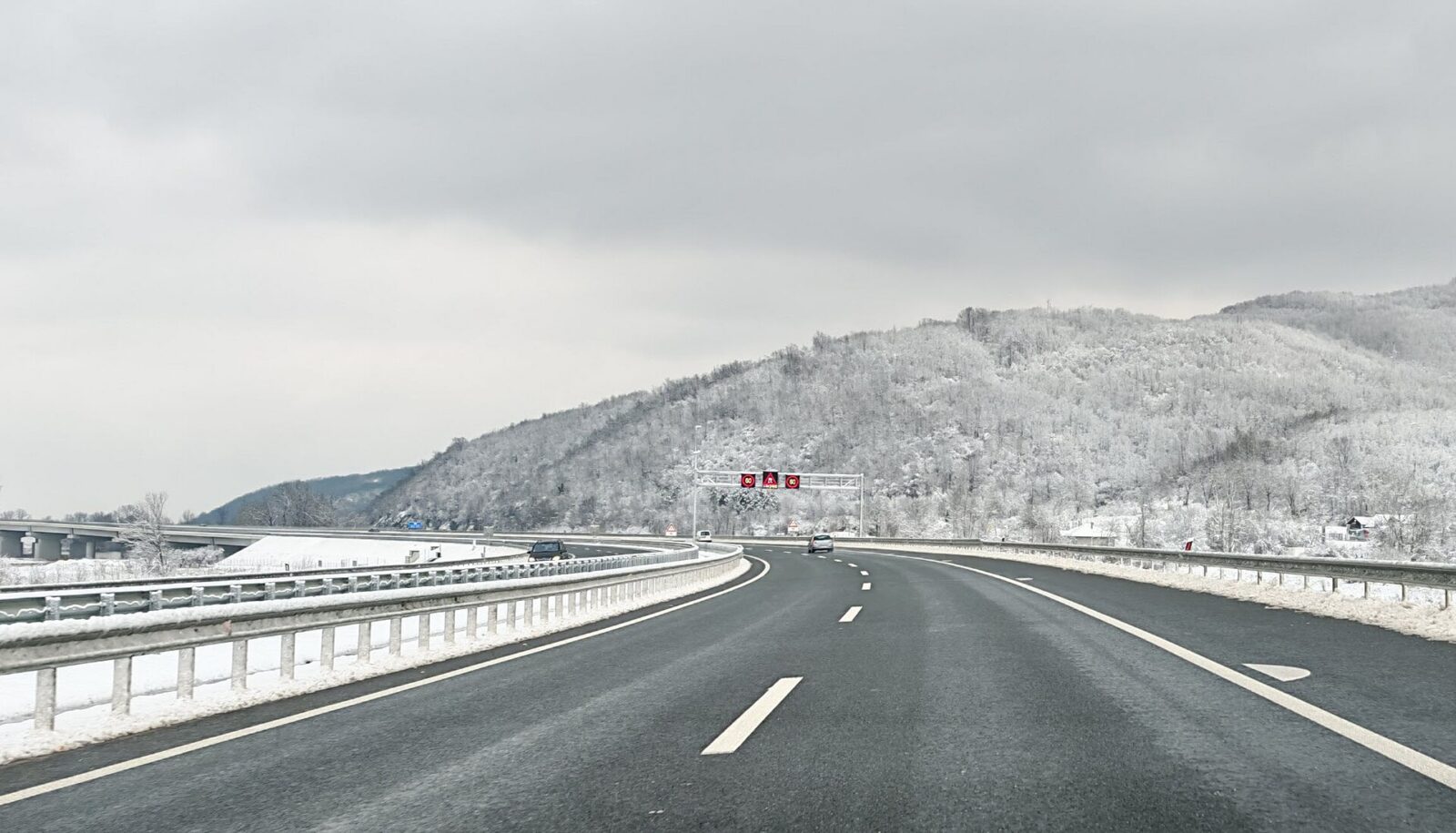
The tourist office names three highway options from Belgrade. The direct option is the Belgrade-Vrnjacka Banja motorway. A second runs on the “Milos Veliki” motorway to Preljina, then continues via Kraljevo. A third takes the Belgrade-Batocina motorway via Kragujevac and Kraljevo, which is the one worth knowing about if you’re also stopping in Kragujevac on the same trip. The page doesn’t rank the three by driving time, so treat the difference as three named routes rather than a recommendation for which is fastest. It also covers driving only; bus and rail connections aren’t part of this particular listing, so check directly with a carrier if you’re not planning to drive.
Common questions
Can I use the pools without staying at Merkur?
Neither the hospital’s site nor the tourist office’s site says. Every price we found for the Aqua centar and the wellness centre is listed as an add-on for hotel guests, which reads as guest-only, but nothing states that a day visitor is turned away either. Call ahead if this matters to your plans.
Do you need a referral to use the hospital’s treatments?
Not something either the hospital’s medical page or the tourist office states. Both describe what the treatments are for, not who can book them or how. If a referral or a doctor’s letter is required, you’d need to ask the hospital directly.
Are all seven springs open to visitors?
The tourist office names seven springs in total, but only four, Topla voda, Sneznik, Slatina and Jezero, are described as still used for treatment. The other three, Beli Izvor, Borjak and Vrnjacko Vrelo, are named without any description of current use, so there’s nothing published either confirming or ruling out a visit to them.
Is there a tourist tax to budget for?
Neither the municipality’s site nor the tourist office’s publishes a rate. If one is charged, expect your hotel to add it at check-in and confirm the figure there rather than guessing in advance.
Does the route from Belgrade pass through Kragujevac?
One of the three named routes does: the Belgrade-Batocina motorway via Kragujevac and Kraljevo. If you’re combining the two towns, that’s the road to look at.
Can I pair this with a visit to Sokobanja?
Nothing published compares the two directly, so this page isn’t going to invent a verdict. Both are Serbian spa towns built around mineral springs and covered here separately, worth reading side by side before choosing rather than trying to fit both into one itinerary.
Nearby
Vrnjacka Banja pairs naturally with Sokobanja, Serbia’s other major spa town, for anyone weighing the two before deciding where to spend a few days. The Belgrade-Batocina route also puts Kragujevac within reach on the way down, with its own memorial park and museums. For the wider trip, our guide to Serbian dinars, cards and costs covers what to carry, and renting and driving a car in Serbia covers what’s needed for anyone driving this route rather than taking the bus.