
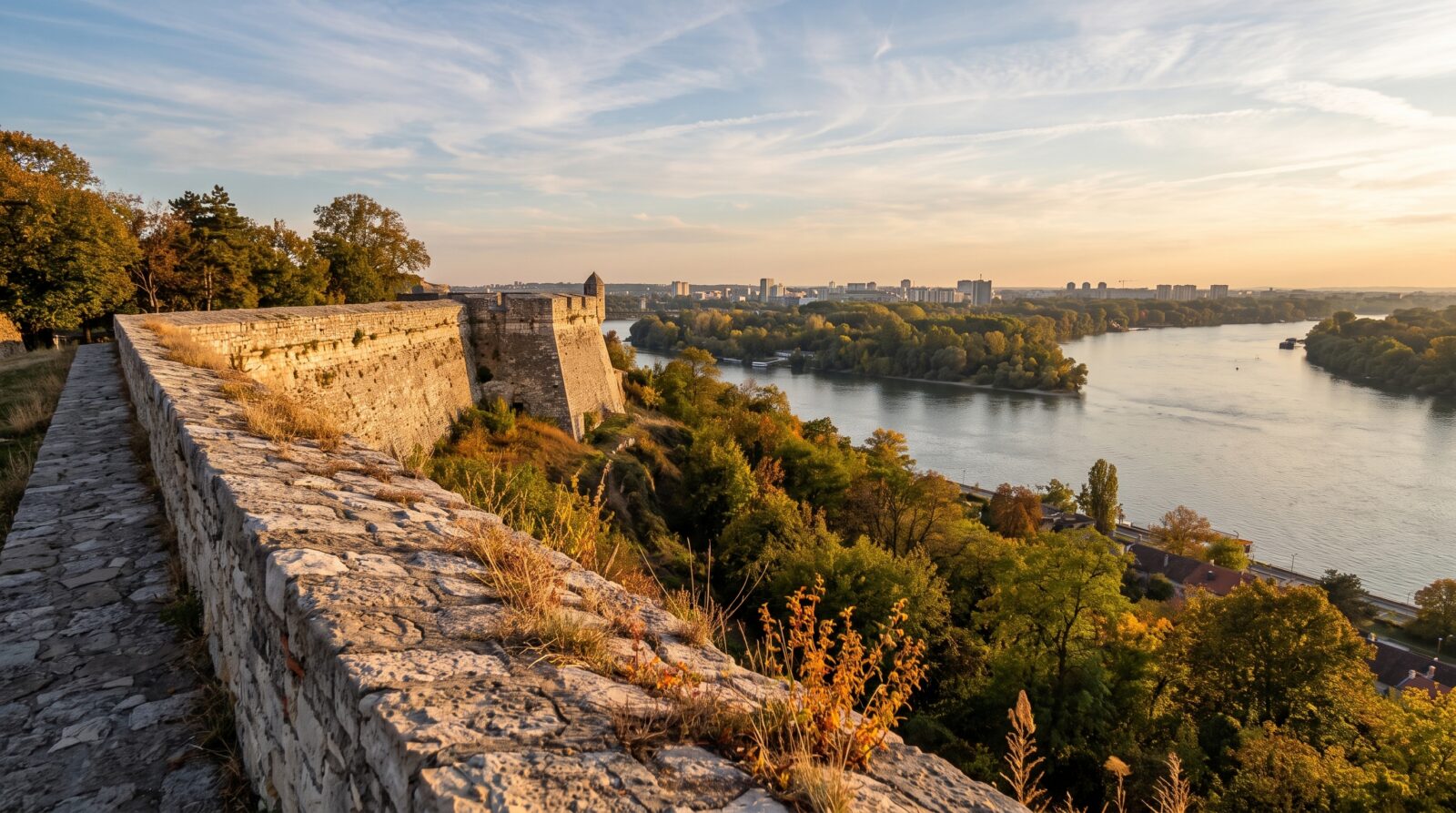
Kalemegdan is where Belgrade explains itself. The park and the fortress occupy the ridge where the Sava runs into the Danube, and the same ground has been fortified, taken, razed and rebuilt often enough that the walls read like a summary of the region’s history. Celts, Romans, Byzantines, Serbs, Ottomans and Habsburgs all held this rock, and each left something in the stone.
Most visitors come for the view and stay for the walk. That is a perfectly good reason, and it costs nothing to plan around. But a little structure helps, because the site is bigger than it looks from the entrance and several of its enclosed parts keep hours and rules of their own.
The short version. Walking the park, the ramparts and the gates needs no ticket from anyone. Five enclosed sites inside the fortress are ticketed individually, from 120 to 400 dinars, and two of them are open only to organised visits announced in advance, all year round. Trams 5 and 10 terminate at the foot of the walls. Give it half a day, or a full one if you want the museums too.
On this page
What Kalemegdan actually is
Two things share one name, and it helps to separate them early. The fortress is the fortified complex on the promontory, walls and gates and bastions, divided into an Upper Town on the crest and a Lower Town on the slope down to the water. Kalemegdan is the park laid out around and below it in the nineteenth century, once the guns no longer needed a clear field of fire.
The name itself is Ottoman, from kale, fortress, and meydan, the open ground in front of one. That open ground is precisely what became the park: the space the defenders kept empty so nothing could approach unseen.
Both are run by a single public company, JP Beogradska tvrdjava, which took charge of them in the early 2000s. That matters in practice more than it sounds: opening hours, prices and closures for everything inside the walls come from one place rather than from a dozen separate attractions with a dozen separate websites.
The layers you are walking on
Almost nothing here is from one period, and knowing roughly which century you are looking at turns a pleasant walk into a legible one.
Roman and Byzantine foundations
The Roman legionary fortress of Singidunum stood on this promontory, and the grid of the modern Upper Town still follows something of its outline. What you can actually see of it is fragmentary: stretches of wall footing, reused blocks in later masonry, and the odd carved fragment set into a rampart by a builder who found it convenient. The city’s Roman past is more legible in the archaeological collections than in the ground.
The medieval Serbian fortress
The site’s most complete medieval phase belongs to the early fifteenth century, when Belgrade became the Serbian capital under Despot Stefan Lazarevic. The Upper Town’s inner citadel and several towers date from that rebuilding, and it is the layer that survives most coherently, partly because so much of it was buried inside later Austrian earthworks rather than demolished.
Ottoman and Austrian rebuilding
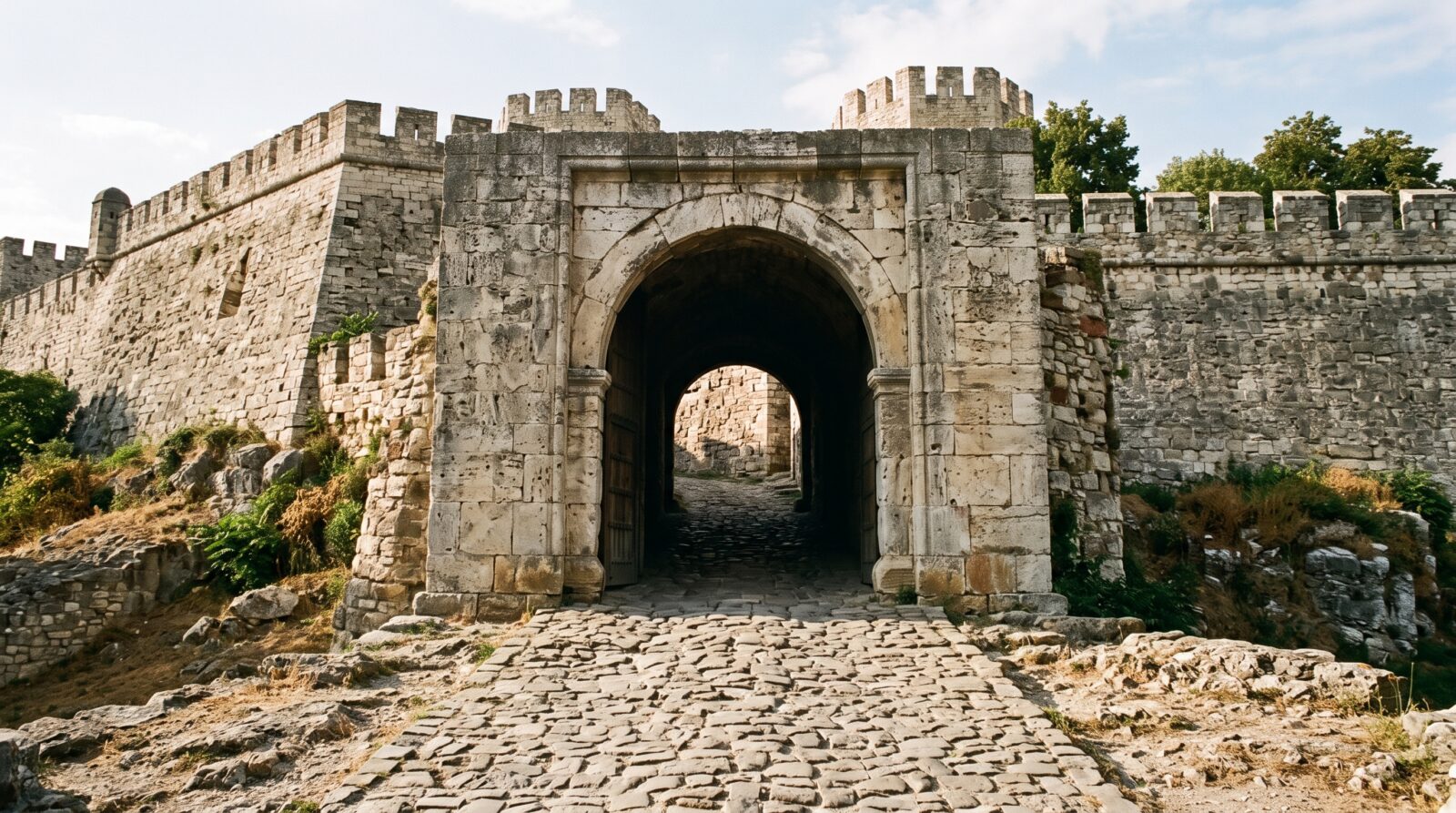
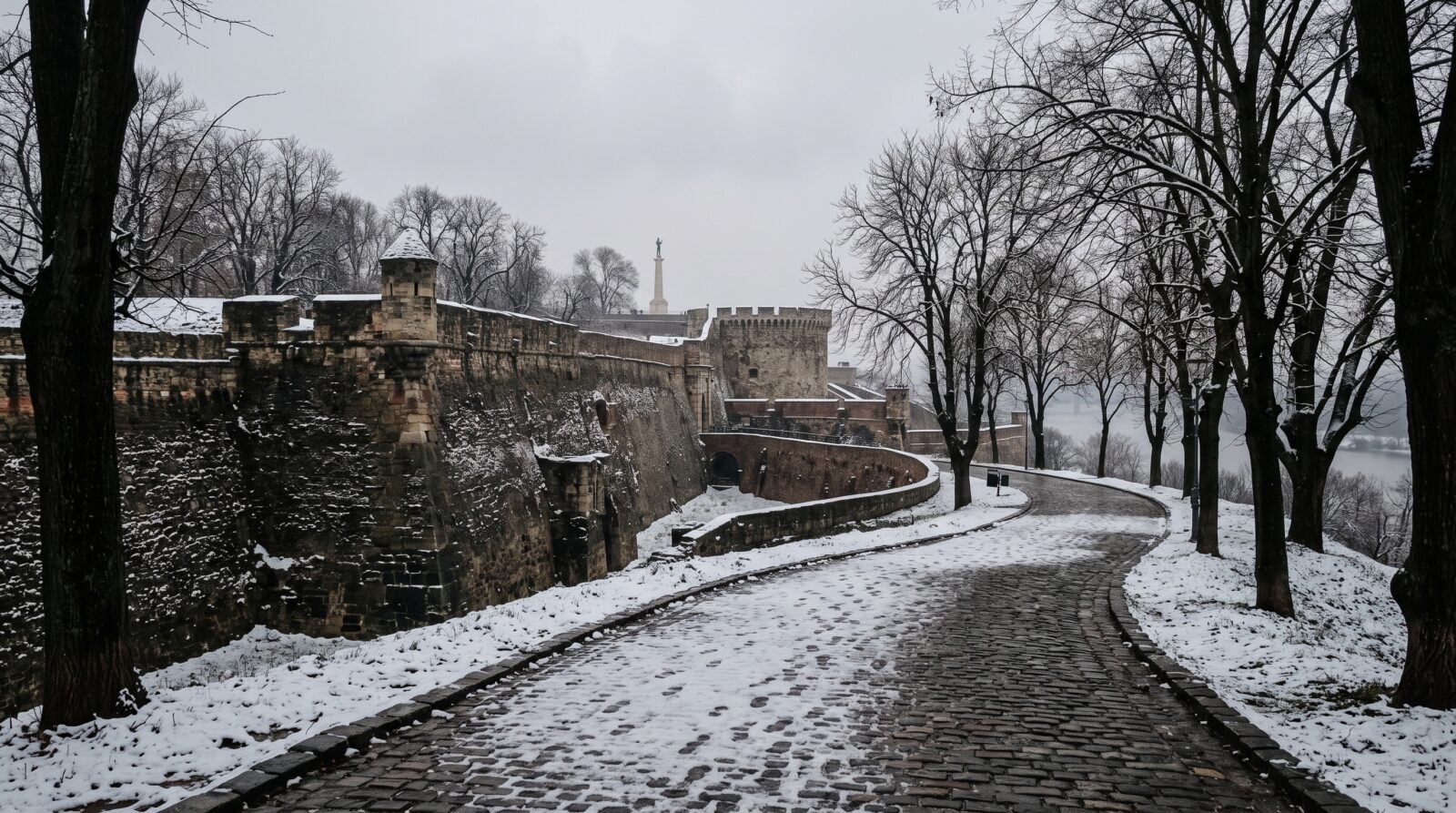
What dominates today is the artillery fortress: low, thick, angular walls designed to absorb cannon fire rather than to look impressive, built and rebuilt through the seventeenth and eighteenth centuries as the frontier moved back and forth. The great gates you pass through, with their long dark vaulted passages, belong to this phase. So does the Hammam near the Sahat gate, and the powder magazines cut into the slope.
What you pay to enter
Belgrade Fortress tickets cover five enclosed sites, ticketed separately, each with its own price. Prices are in dinars, and the reduced rate applies to pupils, students and pensioners. The operator publishes no child rate, no family rate, and no combined ticket covering several sites.
| Site | Full | Reduced | Where | How you get in |
|---|---|---|---|---|
| Casemates, with medieval instruments of torture | 400 RSD | 300 RSD | Upper Town | Hours published April to October; the operator states nothing about visiting without an announcement |
| Nebojsa Tower | 270 RSD | 150 RSD | Bulevar vojvode Bojovica | Open to individual visitors, all year |
| Great Gunpowder Magazine | 270 RSD | 150 RSD | Lower Town | Announced group visits only, all year |
| Roman Well | 170 RSD | 100 RSD | Upper Town | Hours published April to October; the operator states nothing about visiting without an announcement |
| Military Bunker | 120 RSD | 80 RSD | Upper Town | Announced group visits only, all year |
The shop and the gallery at the Sahat Gate are the only two places the operator explicitly marks as free to enter. Everything else in the open air, meaning the park, the ramparts, the gates and the Victor monument, carries no published charge and no ticket desk.
The Roman Well, which is neither
The most atmospheric of the ticketed sites is also the most misleadingly named. It is not Roman, and it is probably not a well: it is an Austrian shaft of the 1720s, some sixty metres deep, with a double spiral staircase winding down around the void. Whether it ever reached water is disputed. What it certainly did was collect legends, and it is worth the 170 dinars if you are comfortable with confined stairs and a long descent.
The Casemates
The most expensive ticket at 400 dinars, and the one whose subject matter divides visitors: the vaulted gun chambers now hold a display of medieval instruments of torture. Taken as an exhibition it is a bit lurid. Taken as an excuse to walk through the interior of an artillery bastion, it is the best access you will get to how these walls actually worked.
When they open
Kalemegdan opening hours follow the season rather than the day. From 1 April to 30 September the ticketed sites run 11:00 to 19:00, with the last ticket sold at 18:30. Through October the day shortens to 10:00 to 17:00, last ticket 16:30. Most of them close on Mondays; Nebojsa Tower runs Wednesday to Sunday, so it closes on Mondays and Tuesdays as well.
Winter is the part worth reading twice. Nebojsa Tower keeps a published 10:00 to 17:00 range from 1 October through 31 March, and so do the shop and the gallery at the Sahat Gate, which are free. The other four ticketed sites publish no opening hours at all between 1 November and 31 March. The operator does not say they are closed, and it does not say they are open: it simply stops publishing. If you are here in January, treat them as unavailable unless you have contacted the operator, and plan a walking visit instead.
Two sites never admit walk-ins. The Great Gunpowder Magazine and the Military Bunker are open, in the operator’s own words, only to organised visits announced in advance, all year round. That is a different and lighter rule from the one on the Casemates and the Roman Well, where an announcement is required for organised groups but nothing is said about individual visitors. Worth knowing: these conditions appear only in the Serbian version of the operator’s page. The English version lists the same prices and drops the footnotes entirely, so a visitor reading it in English would have no way of knowing. No notice period is published, and no minimum group size either. Ask the operator directly, on the fortress information page, well before you plan to go.
Walking the site
Come in from Knez Mihailova, which runs straight into the park, and the site unfolds in a natural order. You can do the whole circuit in ninety minutes without stopping, or spread it across an afternoon.
The park
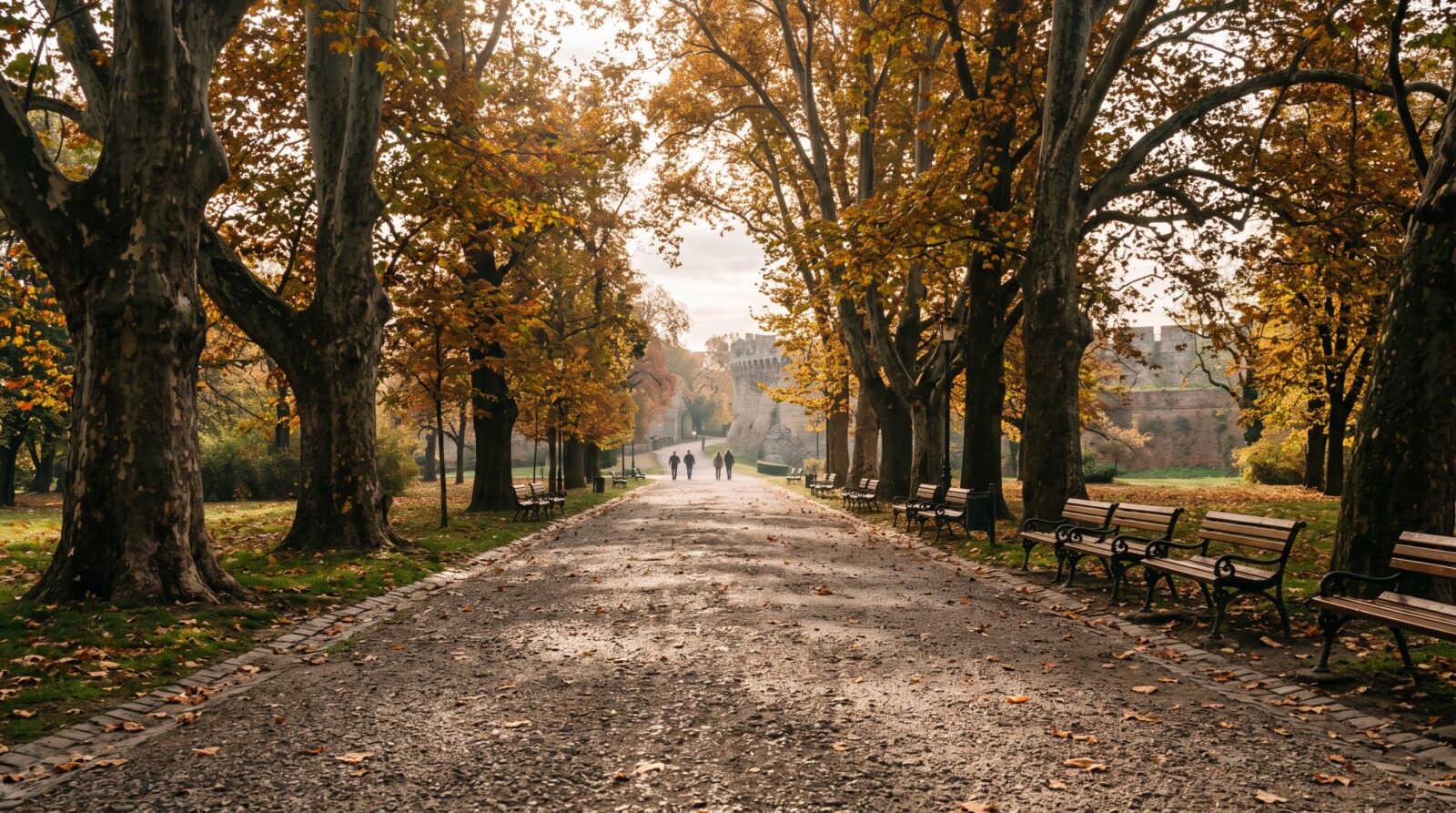
Kalemegdan park is the unticketed part, and the part most people mean when they use the name: broad gravel avenues under mature trees, benches, chess players, and a long balustrade along the edge of the escarpment. It is the city’s front garden and it is used as one: on a warm evening it is full of Belgraders rather than visitors, which is the best argument for coming late in the day.
The Victor, and the view
The bronze figure on a column at the tip of the promontory is the Pobednik, the Victor, and it stands where it does for an awkward reason: the nude male figure was thought unsuitable for a city square, so it was placed facing out over the rivers instead. The result is the best viewpoint in Belgrade. Below and ahead, the green Sava meets the browner Danube in a visible line, with Novi Beograd on one bank and the wooded island of Veliko Ratno Ostrvo in between.
The Upper Town
Inside the walls: the Military Museum with its outdoor line of guns and armoured vehicles, the Clock Tower, the Sahat gate with its shop and gallery, the Roman Well, the Casemates, and open ground where people sit on the grass between the ramparts. This is where most of the ticketed sites are, and where the fortress reads most clearly as a fortress.
The Lower Town
Down the slope towards the water, quieter and much less visited, with the Great Gunpowder Magazine, the ruins of a medieval church, and paths that eventually reach the riverside. Most visitors never come down here, which is exactly why it is worth the descent, though remember it is a climb back.
Booking a guided visit
The Great Gunpowder Magazine and the Military Bunker are the two sites you cannot simply walk into, and a guided tour is the ordinary way to see them. The operator runs its own announced visits, and several underground tours of the fortress are sold online through the main activity marketplaces. We are checking what each one actually enters before we point you at a specific one, because the difference between walking into the Roman Well and walking past it is the whole point of paying for the tour.
Nebojsa Tower
The octagonal tower on the riverbank below the fortress is technically part of the complex but sits apart from it, on Bulevar vojvode Bojovica, a walk down from the Lower Town or a short tram ride. Built in the fifteenth century as a river defence, it later served as an Ottoman prison, and it holds a permanent exhibition on that history.
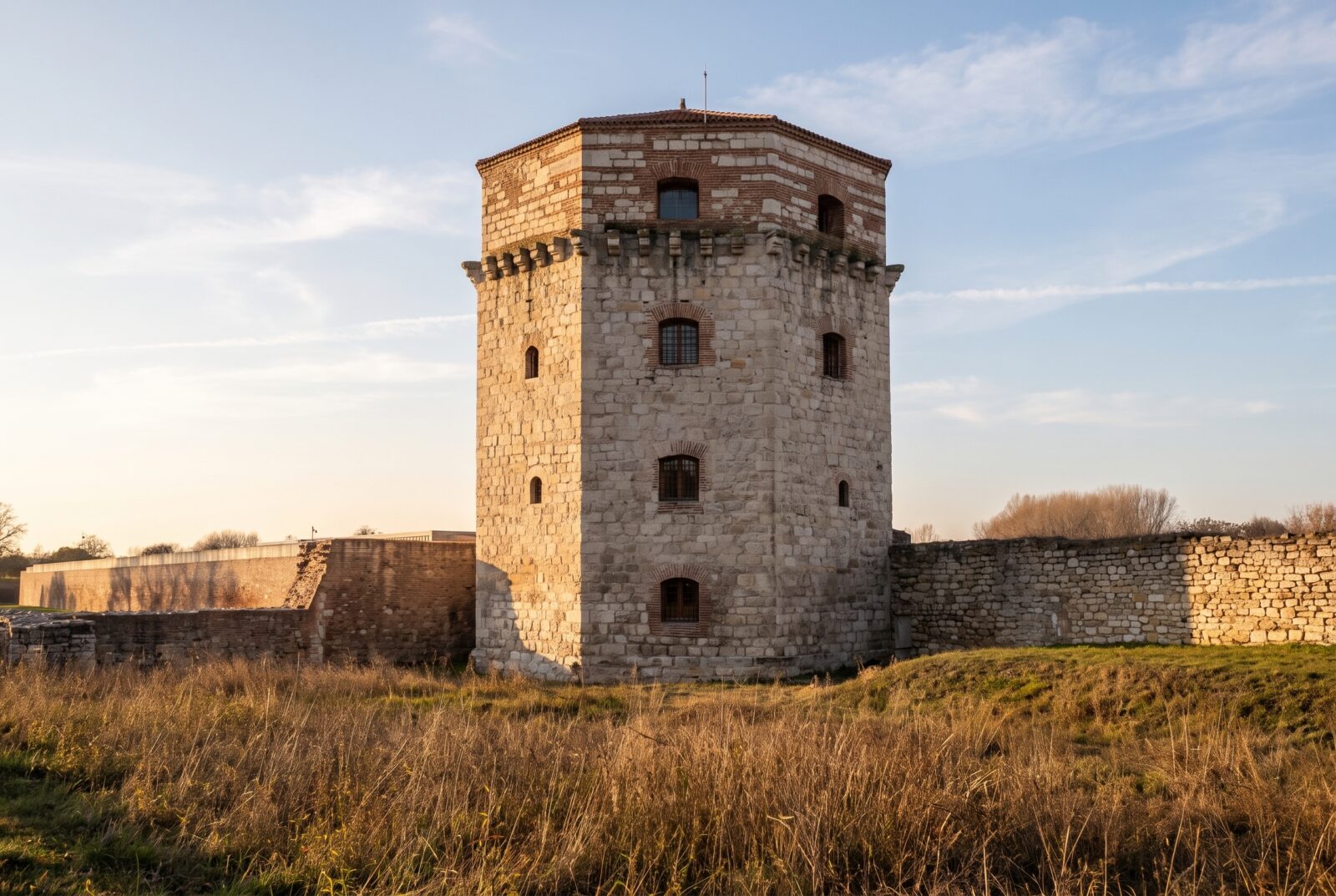
It is the one ticketed site with a published winter timetable, which makes it the reliable choice out of season. Note the different closing days: Wednesday to Sunday, so it is shut on Mondays and Tuesdays when the rest of the site is only shut on Mondays.
Getting there
Trams 5 and 10 both terminate at the Kalemegdan stop in the Lower Town, on Bulevar vojvode Bojovica, which is also where Nebojsa Tower stands. Tram 2L stops on the Pariska side, at the top of the park. Belgrade’s regular public transport carries no fare, so the journey costs nothing whichever line you take.
Coming on foot from the centre is just as easy, and more pleasant: Knez Mihailova runs straight into the park, and the walk from Studentski trg takes a few minutes. From Trg Republike, allow ten.
When to come
Late afternoon, if you can choose. The light falls across the confluence rather than into your lens, the park fills with locals, and the sites you can walk into are still open until 19:00 in summer. Early morning is the quiet alternative, though the ticketed sites do not open until 11:00 in high season.
Out of season the site changes character. From November the Casemates and the Roman Well stop publishing hours, so only Nebojsa Tower stays reliably open among the ticketed sites. The park and the walls are still there, emptier, and arguably better for it.
One thing that changed recently. Since June 2026 the Upper Town gates close overnight, from 00:30 to 04:30, a measure the operator introduced for visitor safety and to protect the site. The park and the Lower Town stay open through those hours. It is unlikely to affect an ordinary visit, but it rules out the old habit of walking up to the ramparts for sunrise.
Common questions
How long do I need?
Ninety minutes covers the park, the Victor and a walk through the Upper Town. Half a day lets you add one or two of the ticketed sites without hurrying. A full day only makes sense if you are also doing the Military Museum and walking down to Nebojsa Tower.
Is it free to walk around?
No ticket desk controls the park, the ramparts, the gates or the Victor, and the operator publishes no admission charge for them. It does not state anywhere that entry is free, so we describe what carries a ticket rather than declaring the rest free of charge. In practice you will not be asked to pay to walk in.
Can I do it with a pushchair or a wheelchair?
The park and the main avenues are flat and surfaced, and the operator states wheelchair access to the palace in the green zone. The ramparts, the Lower Town descent and the Roman Well stairs are another matter and are not accessible.
Is there anything for children?
The park holds Belgrade’s zoo and a small dinosaur park, both ticketed separately by their own operators, plus a good deal of open space. The Military Museum’s outdoor line of tanks and artillery is usually a hit.
What about the Military Museum?
It sits inside the Upper Town and is run separately from the fortress operator, with its own hours and ticket. The outdoor display of guns and vehicles along the rampart is open to anyone walking past.
Nearby
Kalemegdan sits at the end of the old centre, so it combines with almost anything. A short stay in Belgrade usually starts here. Knez Mihailova leads back to Trg Republike and the National Museum; Dorcol and the places to eat are a few minutes east; and the free tram network puts the rest of the city within reach. Further out, but on the same day if you want them, are the temple of Saint Sava and the Nikola Tesla Museum.