
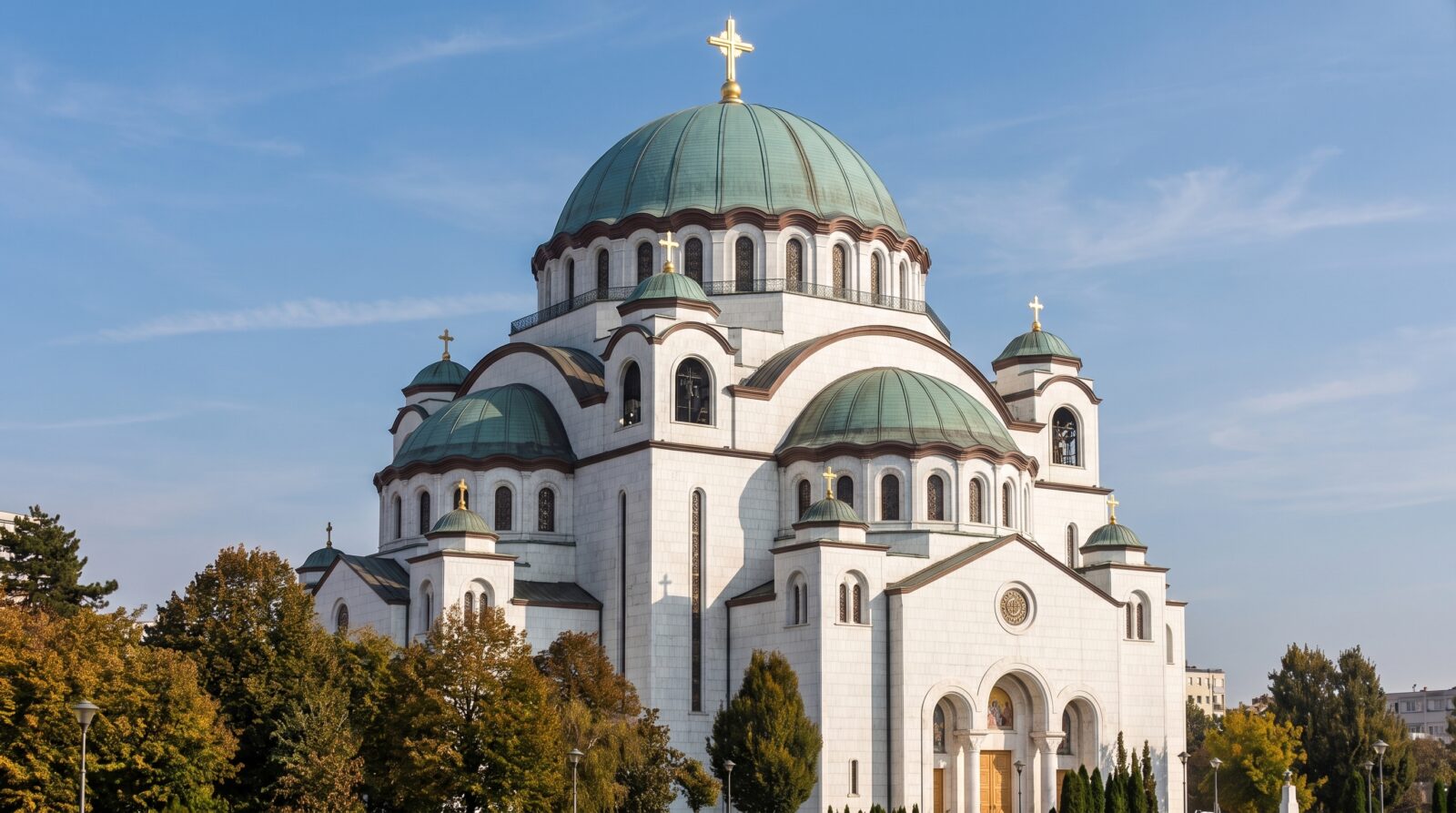
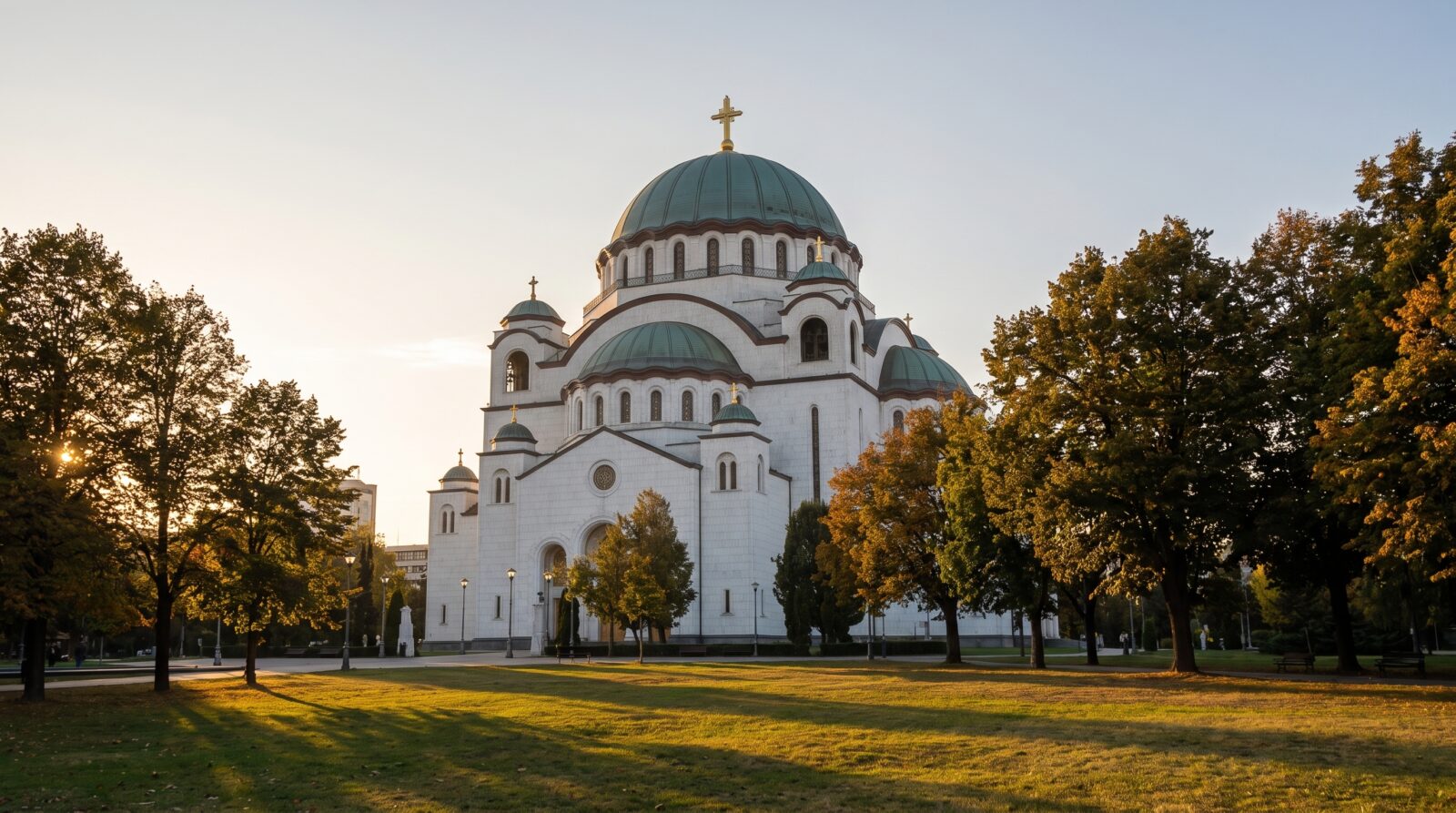
The Temple of Saint Sava is the largest Serbian Orthodox church in the country, standing on the high ground of the Vracar plateau where its dome is visible from much of Belgrade. Tradition holds that the site marks the spot where Ottoman authorities burned the relics of Saint Sava, the founder of the medieval Serbian church, in 1595, and the memorial temple was raised, over a very long construction, to answer that loss on the largest scale the city could manage.
In English the building is called either the Temple of Saint Sava or the Church of Saint Sava; both names refer to the same domed church on Vracar. What stands on the site today is really two separate buildings, plus a crypt beneath the larger one, and visitors who expect a single church often leave unsure which one they actually saw. Getting the two straight, and knowing what each part does and does not publish about price and hours, saves a wasted trip.
The temple was conceived from the outset as a national monument rather than a single congregation’s parish church, which is part of why it is treated in guidebooks and on official pages as one of the city’s defining sights rather than as one church among many. That ambition also explains why the building took shape in stages, decades apart, rather than in one continuous campaign, and why a much smaller church already stood on the same plot long before the larger one reached its current form.
The short version. The memorial temple stands 79 m to the top of its cross and holds up to 10,000 worshippers under its dome. It opens daily from 08:00 to 20:00, with a Sunday liturgy at 09:00 and an evening service every day at 18:00. A separate, much smaller church built in 1935 stands beside it, with its own hours, 07:00 to 19:00. In the crypt beneath the temple, the church of Saint Prince Lazar is open to visitors; the section where patriarchs are buried is closed. A car park and forecourt project is under way outside, with no announced effect on the interior.
On this page
Two buildings, one name
Two structures share the site, and it is worth separating them before anything else. The large domed building most photographs show is the memorial temple, built on a scale meant to match Saint Sava’s standing in Serbian history. A short walk away stands a much smaller church, built in 1935, that predates the giant building beside it by decades and is easy to overlook once the larger dome is in view.
The two keep different hours, and the source that publishes both schedules exists only in Serbian, so there is no official English page to cross-check against a translation tool.
Because the two buildings operate on their own footing, a visit to one says nothing about the other. Coming specifically for the dome and its mosaic means coming to the large memorial temple; the small 1935 church nearby serves a quieter, more ordinary role as a working parish church, and has no ticketed sights of its own to plan around.
| Building | Hours | Notes |
|---|---|---|
| Memorial temple (the large dome) | 08:00-20:00 daily | Sunday liturgy at 09:00, evening service daily at 18:00 |
| Small church, built 1935 | 07:00-19:00 daily | Separate building, no ticketed access |
Sunday liturgy and daily services
The memorial temple holds a liturgy at 09:00 on Sundays and an evening service every day at 18:00, according to the temple’s own published schedule. A visitor arriving during a service can still go in, but expect the nave to be in active use rather than a quiet space for photographs.
What it costs to enter
Most visitors expect a ticket desk of some kind at a building this size. There is not one, or at least not one that publishes a price.
That silence should not be read as a green light in either direction. A source that never mentions a price is not confirming free entry any more than it is confirming a paid one; it has simply chosen not to publish the information. Guides and blogs that flatly state the temple is free, or that quote a specific figure for an individual ticket, are going further than any official source goes.
No individual admission price is published, anywhere. The temple, the Serbian Orthodox Church, the City of Belgrade and the national tourism board are all silent on what an individual visitor pays to enter the memorial temple or the crypt beneath it: no ticket price, no ticket desk, and no statement that entry is free. The only admission figures published anywhere are group rates of 5, 10 and 20 EUR, quoted specifically for groups booked through the temple’s own pilgrimage agency, not for a visitor arriving alone. Third-party booking sites that list a per-person entry fee are not the operator, and their figures are unconfirmed. The temple’s gatehouse telephone, +381 11 24 32 585, is the only contact the operator itself publishes, and calling ahead is the only way to find out what you would actually pay.
Inside the Saint Sava crypt
Below the nave, the Saint Sava crypt covers roughly 2,000 square metres and took about six months to build, across 2001 and 2002. The original plan called for a deeper structure, but builders halved the depth once they ran into the tunnel reserved for the city’s future metro line; what exists today reaches about seven metres down, reached through four separate entrances.
Not all of it is open. The church of Saint Prince Lazar, the section built for worship, is open to visitors. The section where patriarchs of the Serbian church are buried is closed, a structural division rather than a temporary restriction: Patriarch Irinej, buried there after his death, was the first patriarch interred in the crypt. The ceiling paintings, worked on easels more than twenty metres long, were completed between 2013 and mid-2015, and the crypt has hosted cultural events since 2015 and church services since 2016. No opening hours specific to the crypt are published separately from the temple’s own.
The contrast with the bright, echoing nave above is part of what makes the crypt worth the detour: a lower, more enclosed space, densely painted from floor to ceiling, that rewards slowing down rather than passing through on the way to somewhere else.
Works on the forecourt
Expect construction outside. The City of Belgrade has works under way on the plateau in front of the temple: a 356-space underground car park on Skerliceva street, beneath the forecourt by the National Library, with the surface above to be replanted once the car park is finished. No closure of the temple’s interior has been announced, and nothing suggests the works affect visiting hours, but the approach and the immediate surroundings are a building site for now rather than the open plaza many photographs still show.
The dome and its mosaic
The dome is the temple’s defining feature: an inner diameter of 30.5 m opening into an outer diameter of 39.5 m, with 27 m of vault height inside. Above it, the temple rises 79 m to the top of its cross, on a footprint measuring 91 m east to west and 81 m north to south, large enough that the ground floor and its galleries together hold up to 10,000 worshippers.
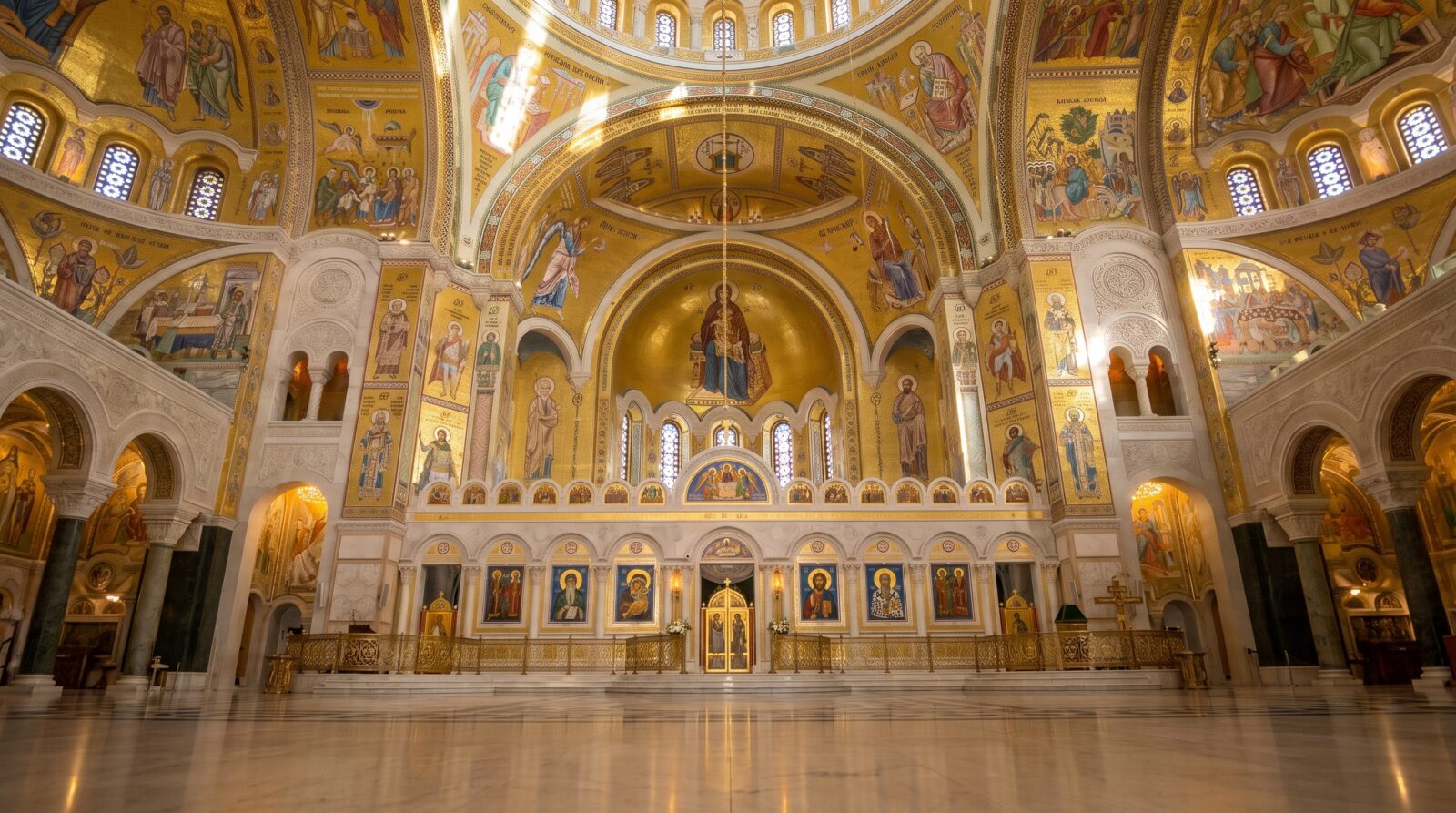
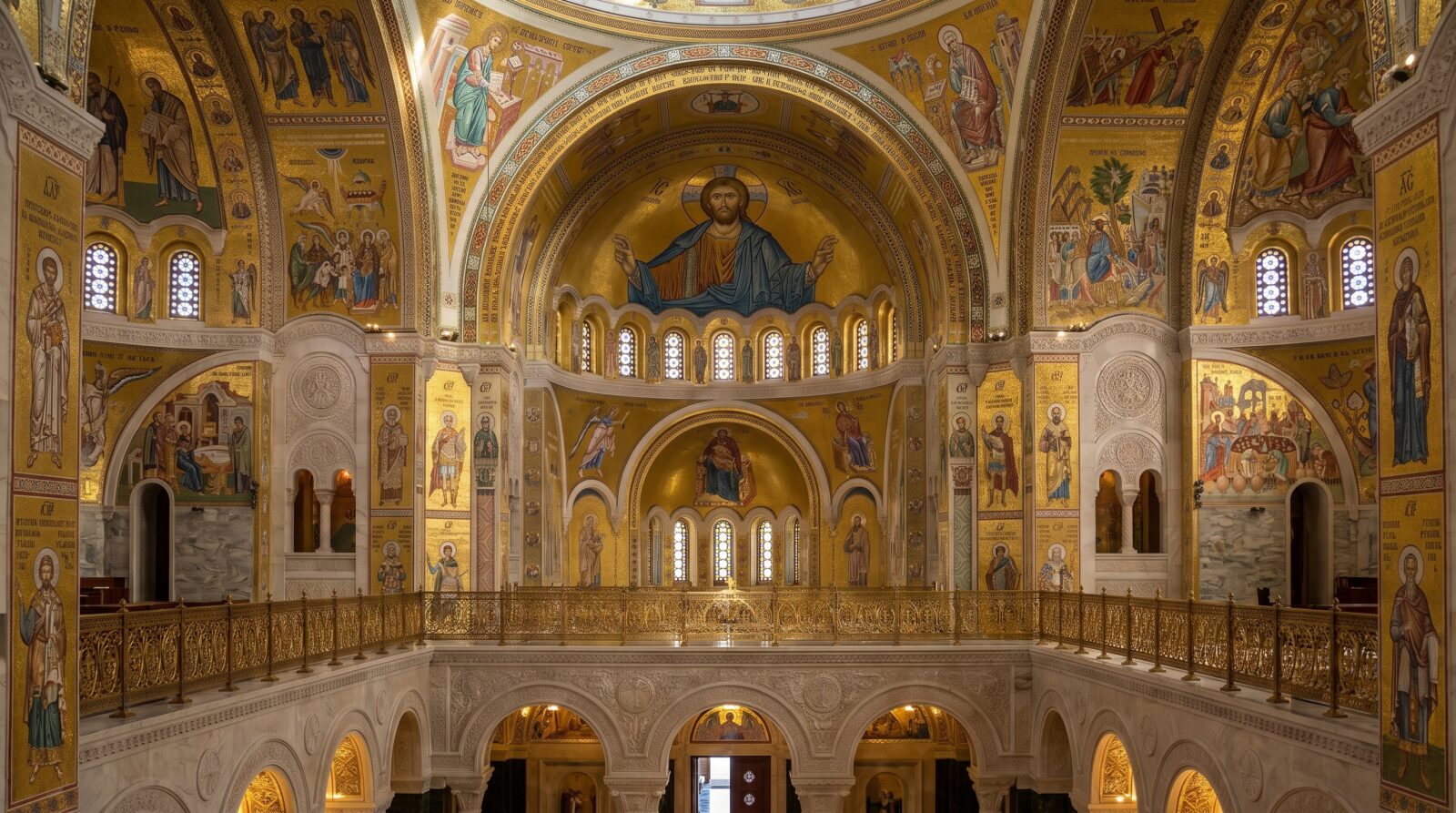
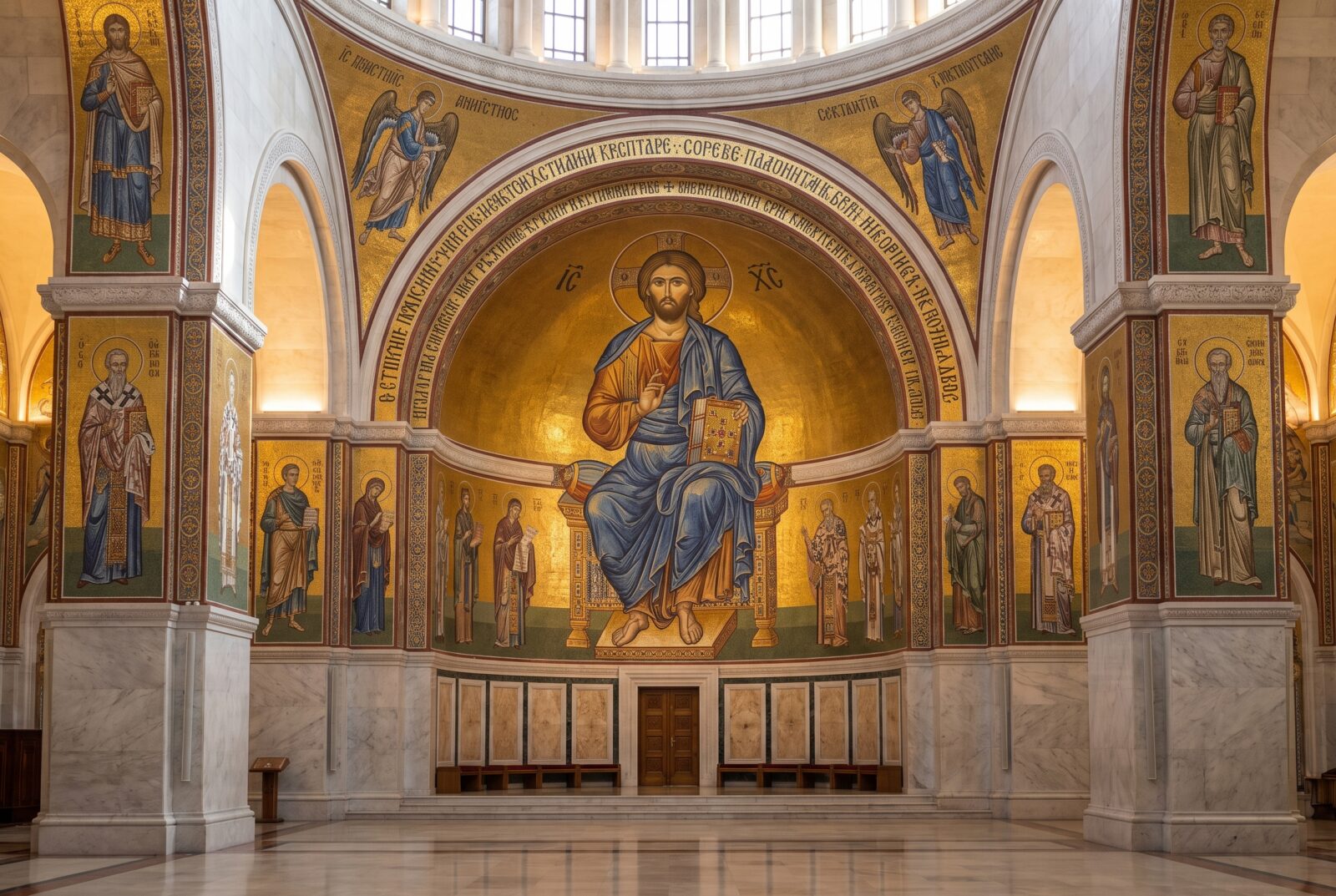
The dome’s inner surface carries a mosaic of the Ascension of Christ, 1,248 square metres of smalt and natural stone, laid between 2016 and 2020 under a 4 million euro donation agreed in 2016 and directed by the artist Nikolaj Muhin. Serbia’s national tourism board separately gives a figure of almost 15,000 square metres of mosaic for the temple as a whole. Neither source states exactly what the other one counts, so the two figures do not describe the same thing: they should not be added together or compared directly. The dome alone accounts for the smaller number; the entire building, for the larger one.
Standing beneath it, the biblical scene of Christ’s Ascension unfolds across a curve too large to take in from any single point on the floor, laid out to be seen from thousands of positions at once, on the ground and from the surrounding galleries. Photographs of the dome flatten that scale into something that looks almost decorative; in person, the size is the point.
Raising the dome
The dome itself, weighing about 4,000 tonnes, was not built in place. It was assembled at ground level and pushed up to its final height of about 40 m by sixteen hydraulic jacks, a technique the operator’s own page describes in some detail. That same page gives two different date ranges for when the lift took place, one spanning November 1988 to February 1989 and another describing a twenty-day operation in May and June 1989. Since the source contradicts itself, this page does not repeat either date; the weight of the dome and the method used to raise it are the parts worth remembering.
The gallery above the dome
A circular outer gallery runs around the dome about fifty metres above the base of the temple, covering roughly 180 square metres by the operator’s own approximate figure. It is the only vantage point of its kind on the building, but the operator publishes no access conditions, no hours and no price for visiting it, so this page does not describe how, or whether, an individual visitor can get up there. If the gallery matters to your visit, the gatehouse telephone is the way to find out before you arrive.
Getting there
The temple stands at Krusedolska 2a, in the Vracar municipality, close enough to the centre to reach on foot from much of Stari Grad. Public transport on both sides of the building is free, part of Belgrade’s fare-free network for regular city and suburban lines. On the west side, the Karadjordjev park stop, about 280 m from the temple, serves trams 8, 10 and 14 along with several bus lines. On the east side, the Macvanska stop, 300 to 450 m away, serves trolleybuses 19, 21, 22 and 29. Either stop puts you within a few minutes’ walk of the forecourt, and since every regular line is fare-free, there is no reason to choose one route over another on cost.
A stop called Krusedolska also appears in the transport authority’s database, but it sits near Surcin, roughly twenty kilometres away, and has nothing to do with the temple despite sharing the name of its street. Do not aim for it.
One practical warning for anyone searching online: an old domain ending in .com still carries the temple’s name but now serves unrelated commercial pages. The official site is hramsvetogsave.rs.
Common questions
Are the temple and the small church next door the same building?
No. The large domed building is the memorial temple; a much smaller church, built in 1935, stands beside it as a separate structure with its own hours, 07:00 to 19:00, against the temple’s 08:00 to 20:00. Many visitors photograph one and assume it is the other.
How much does it cost to enter the temple or the crypt?
No individual admission price is published for either. The only figures available anywhere are group rates through the temple’s own pilgrimage agency, which do not apply to a visitor arriving alone. Call the gatehouse on +381 11 24 32 585 if you need to confirm before you go.
Which parts of the crypt can I visit?
The church of Saint Prince Lazar, built into the crypt, is open. The section where Serbian patriarchs are buried, including Patriarch Irinej, is closed to visitors, and this is a permanent division rather than a temporary closure.
Can I go in while a service is being held?
Yes, but expect the nave to be in use rather than free for quiet viewing. The temple holds a liturgy at 09:00 on Sundays and an evening service every day at 18:00.
Is the area around the temple currently under construction?
Yes. Belgrade is building an underground car park beneath the forecourt, with the surface above to be replanted afterwards. The operator has not announced any effect on the temple’s interior or its hours.
Can I go up into the gallery above the dome?
The operator describes a circular gallery roughly fifty metres up, covering about 180 square metres, but publishes no hours, price or access conditions for it. This page cannot tell you whether an individual visitor is admitted; ask at the gatehouse, on +381 11 24 32 585, if it matters to your visit.
Nearby
The temple sits a short ride from the rest of central Belgrade. The city’s fare-free tram and trolleybus network reaches it directly from Stari Grad, and it combines naturally with a short stay in Belgrade. Further into the old centre, Kalemegdan and Belgrade Fortress cover the medieval and Ottoman layers of the city, while the Nikola Tesla Museum covers a much more recent one.