
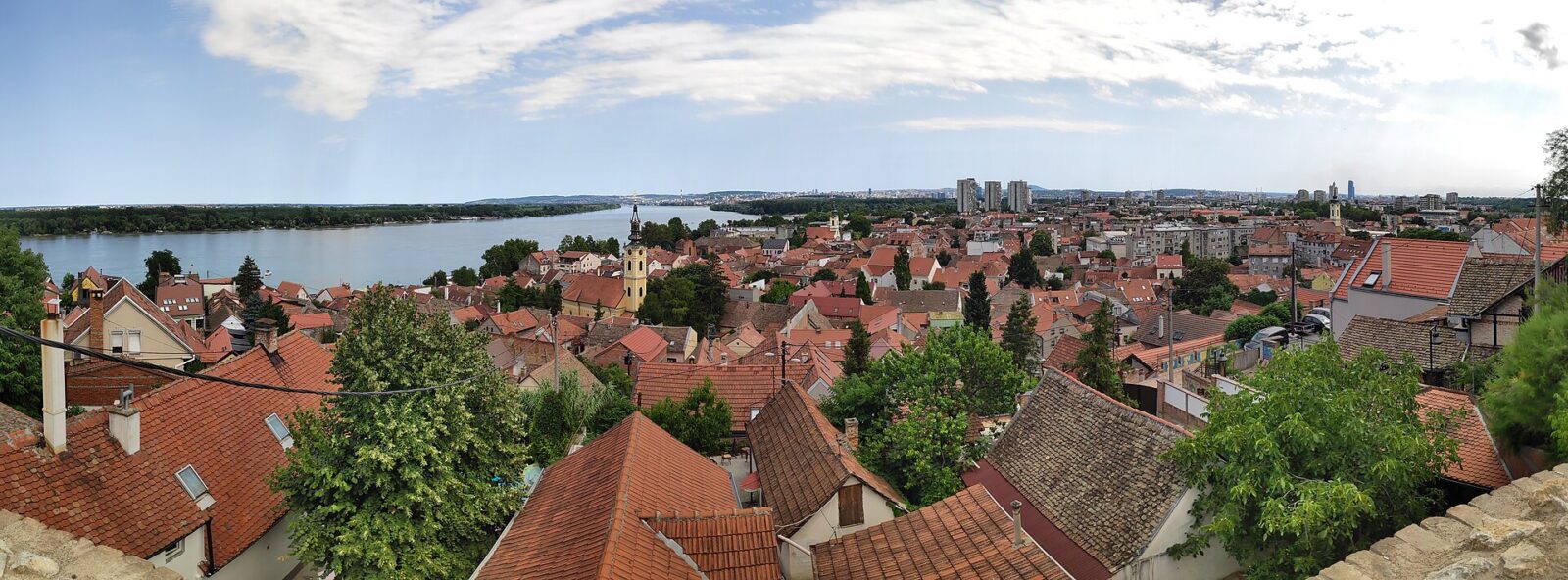
Zemun keeps its own skyline low across the water from central Belgrade, and the hill above its old town, Gardos, is the reason. A stone tower and a network of narrow streets sit on ground that belonged to a separate administrative town within living memory of the older buildings still standing there, before it became one quarter among Belgrade’s seventeen.
Most of what draws a visitor here sits inside a small area: the Millennium Tower on Gardos hill, a riverside quay laid out in the 1880s, and the old core between them. None of it is far from the water, and none of it needs a car to reach, since Zemun sits on the same free public transport network as the rest of Belgrade.
The quarter reads differently from the parts of Belgrade most visitors see first. Where Kalemegdan and Knez Mihailova sit on the promontory the Sava and the Danube meet at, Zemun sits further along the Danube’s own bank, with a street pattern and a scale that still trace back to when it was governed on its own rather than as part of the capital across the water. That history shows up less in any single monument than in the general grain of the place: a hill town with its own riverside promenade, rather than a set of standalone sights arranged for visitors.
What follows sets out the tower’s height and history, the viewpoint at the top of the hill, the quay below it, and how Zemun fits into Belgrade’s administrative map today. It also says plainly where this page could not confirm a fee or an opening time, rather than guessing at either, because a wrong guess would cost you more than an honest gap in the information.
The short version. The Millennium Tower on Gardos hill, 36 metres high, was built by the Hungarian authorities in 1896 and last thoroughly renovated in 1962. The hill itself stands at elevation point 111, Belgrade’s own reference point for the best view over Zemun’s old core to the Danube. No admission fee or current opening hours are published for the tower by any institutional source, so this page does not state either. Zemun was a separate Free Royal Town until it became one of Belgrade’s city municipalities; it is one of the ten central ones today. Getting there costs nothing regardless of which bus or tram you take: Belgrade’s public transport has carried no fare since 1 January 2025.
On this page
What it costs to visit the tower
No admission fee for the Millennium Tower is published anywhere official. Zemun’s own municipal page describes the tower’s history in detail but says nothing about ticketing. The Tourist Organisation of Belgrade states the tower is open to visitors but names no price. The Museum of the City of Belgrade, which might otherwise be expected to run it as a branch, does not list it among its sites at all; the “Zavicajni muzej Zemuna” it does list occupies a different building, so it cannot be assumed to also manage the tower. An absence of a published fee is not evidence that entry is free: it is simply something none of the sources checked here states either way, and this page is not going to guess at a number none of them commits to.
When the tower is actually open
No specific hours are published for the tower either. The Tourist Organisation of Belgrade’s own page, in both its Serbian and English versions, states that the tower is open for visitors every day, without giving a time range. Neither that page nor Zemun municipality’s own page, which describes the tower only in the past tense as something “last thoroughly renovated in 1962… opened to visitors,” carries a content date recent enough to treat as a current operational statement. Call ahead or check locally before planning your visit around it, rather than assuming it will be open at whatever hour suits your schedule. If you only have the view from the hill in mind rather than the climb inside the tower itself, none of this uncertainty applies: the hill and the streets around it are open ground, with no gate and no published hours of their own.
| Confirmed | Not established | |
|---|---|---|
| Height | 36 metres | – |
| Built | 1896 | – |
| Admission fee | – | No fee published by any source checked |
| Opening hours | – | Described only as “open daily”, no time range, on an undated page |
Getting to Zemun without a car
Belgrade’s public transport, trams, buses and trolleybuses alike, has carried no fare since 1 January 2025, and Zemun’s connections into the rest of the city fall under that same rule. Whatever route you take, the ride itself costs nothing, which makes Zemun one of the easier half-day additions to a Belgrade stay: there is no ticket to buy before you set off and no fare to budget for the return trip either.
The city transport operator’s own line list shows two regular bus lines naming Zemun as a terminus, line 15 between Zeleni Venac and Zemun, and line 17 between Konjarnik and Zemun, both central departure points used elsewhere on this site. The same list also names two further lines reaching a Zemun quay terminus, line 82 and a line called Ada 2, though this page has not cross-checked whether that quay stop is the same stretch of riverside covered below. None of these listings carries a visible content date, so treat all of them as a starting point for planning rather than a guaranteed current route, and confirm the specific stop you need once you are travelling.
Walking Gardos hill
Gardos is the hill above Zemun’s old town, and it holds both the tower most visitors come to see and the viewpoint that makes the climb worth it even without going inside.
The Millennium Tower
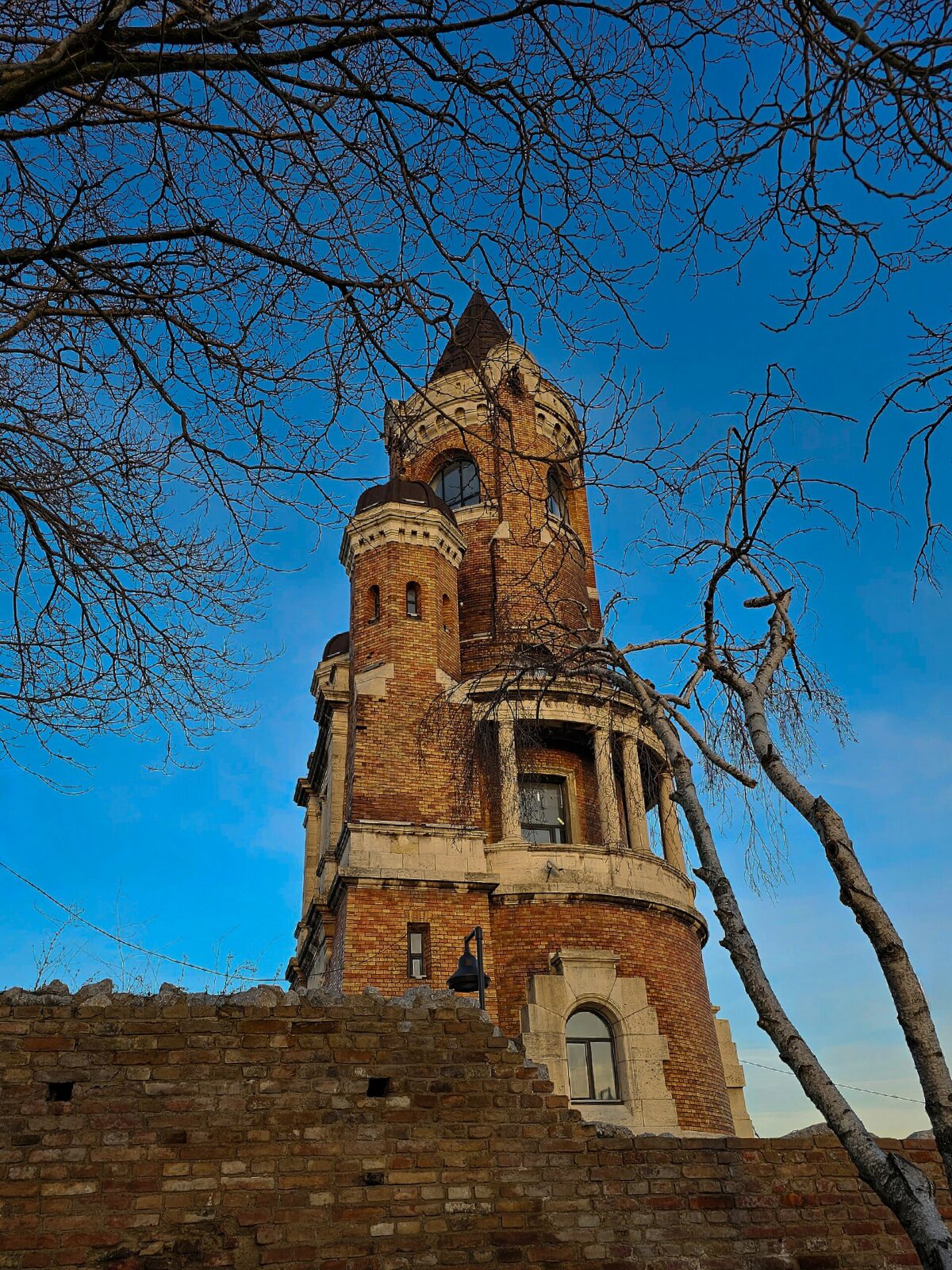
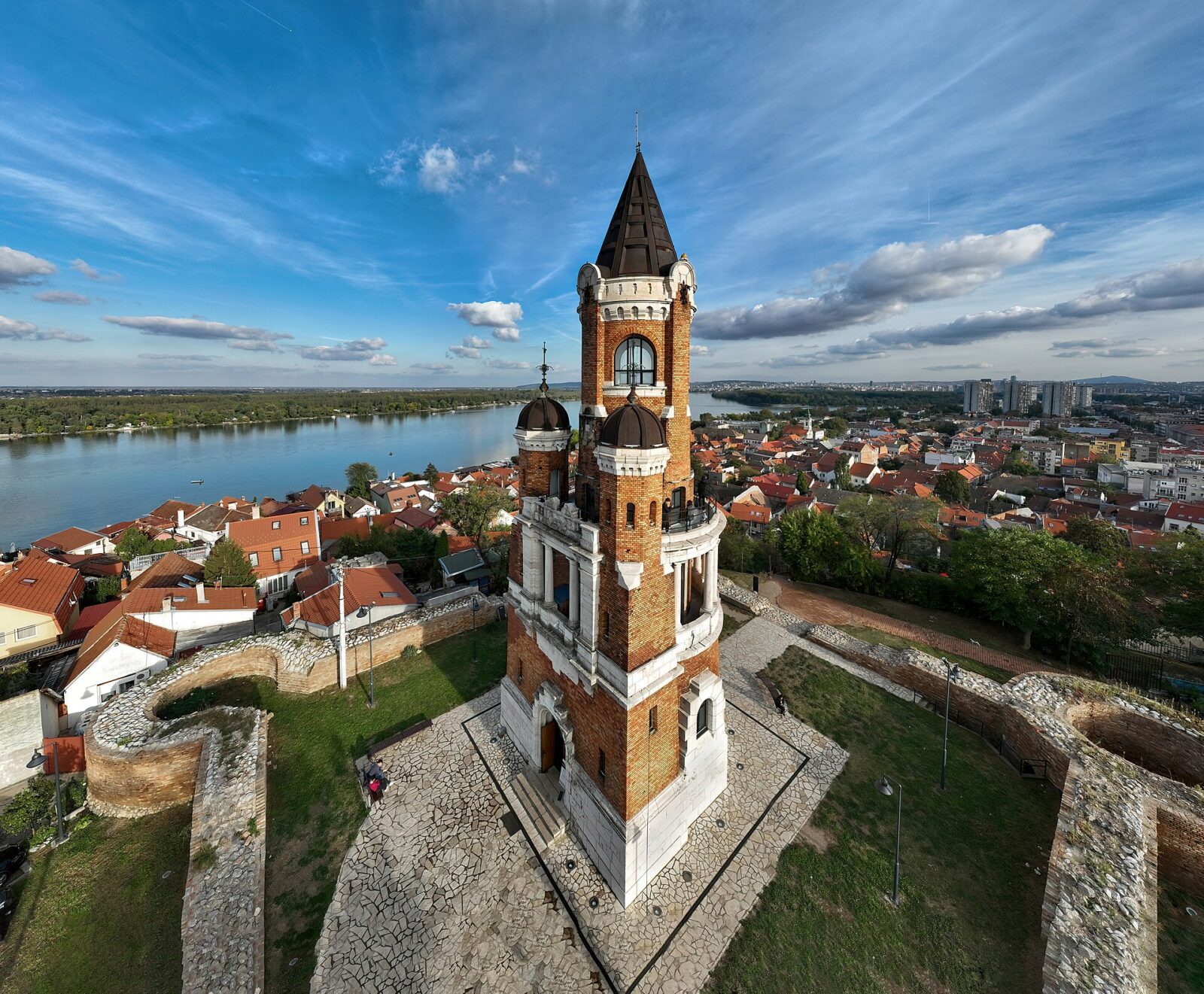
The Hungarian authorities built the tower in 1896, in a mixture of historical styles, as a memorial marking the millennium of Hungarian statehood and this region’s long belonging to the Kingdom of Hungary. It stands 36 metres high in the middle of a square-plan fortification, tall enough to clear the roofline of the old town below it and remain visible from the Danube. The tower was damaged in 1914, in the fighting between Serbia and Austria-Hungary, and repaired in the postwar years; it was last thoroughly renovated in 1962, when it reopened to visitors. It once housed a tourist information point and the studios of two Zemun painters, a use that speaks to how central the building has long been to the town’s own sense of itself, whatever it houses today. Locally, it is known as the Tower of Sibinjanin Janko, after Janos Hunyadi, a name still used alongside its official one.
The view from kota 111
Zemun’s own reference material marks Gardos at elevation point 111 and calls it the most important viewpoint on the left bank of the Sava within Belgrade, with a view over the old core of Zemun to the Danube and Belgrade beyond it, and further out to Zvezdara and the Visnjica hills in the background. You do not need to go inside the tower to get this view: the hill itself is the vantage point, and the tower simply stands at the highest part of it.
It is a different kind of view from the one at Kalemegdan, on the other side of the confluence: rather than looking straight down onto the point where the Sava meets the Danube, you are looking along the river’s own bank, with the old town’s rooftops in the foreground rather than open water. Both views are worth having if your stay allows for both; neither substitutes for the other.
Walking the quay
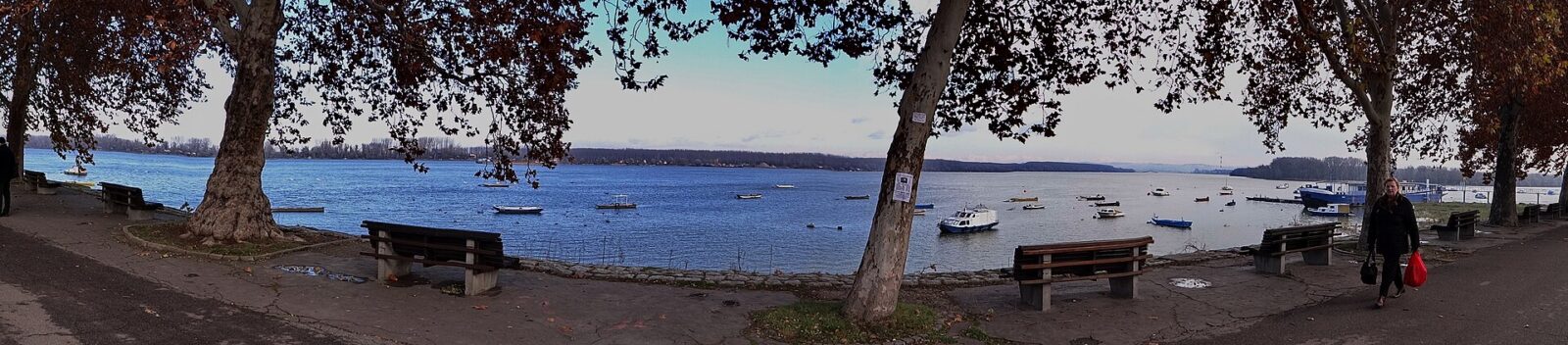
Down from the hill, the Zemun quay runs along the Danube. It was built between 1886 and 1889 as a flood-defence embankment against the river, and by the early 1890s it had become Zemun’s second promenade, a role separate from its original engineering purpose. The embankment was later raised, and after the war the bank and its green spaces were developed further, out towards the Hotel Jugoslavija; the construction of Novi Beograd eventually linked the quay to the Sava’s left bank as well, tying a piece of nineteenth-century flood defence into the modern city’s own riverside geography. The long-established Zemun restaurant Venecija sits directly on the quay today.
It is a level, easy walk rather than a climb, and it works well as the second half of a visit that starts up on Gardos: down the hill, along the water, and back into the old town’s narrow streets from the riverside end. There is no ticket to buy and no gate to pass through anywhere along it, so the only real planning decision is which direction to start from.
From free town to city municipality
Zemun held the status of a Free Royal Town under a law on the organisation of towns in the Military Frontier, dated 8 June 1871, and it still held that status in 1886 when its town hall was built. That status is corroborated separately by the Museum of the City of Belgrade’s own account of the same law and the same date, so this is not a single institution’s claim standing alone. Belgrade today is divided into 17 municipalities, ten of them central, and Zemun is one of the ten. Gardos itself, along with names like Dorcol, Savamala and Skadarlija elsewhere in the city, is a neighbourhood name rather than a separate administrative unit: the municipalities themselves use these names, but the official division of the city stops at the municipality level.
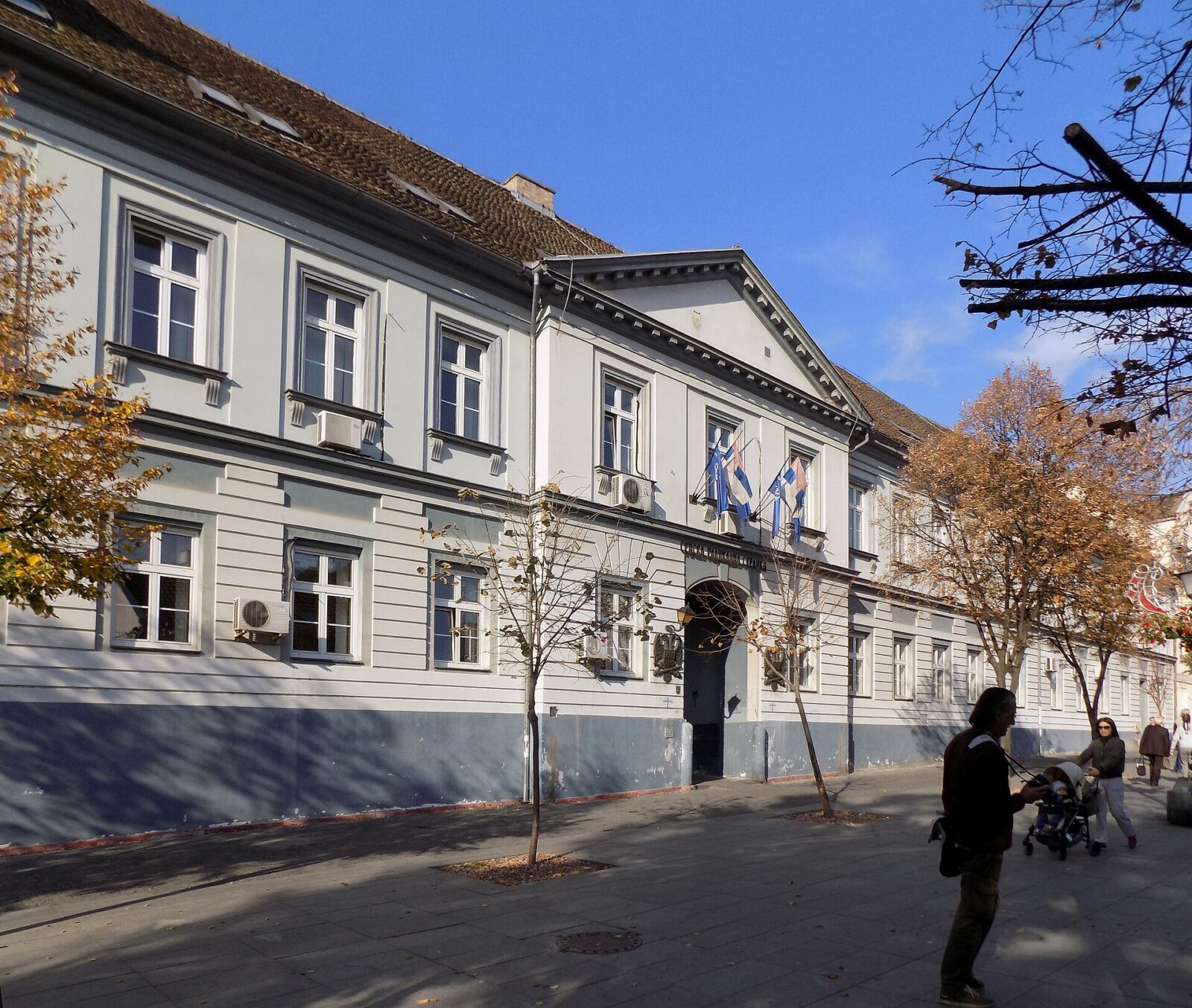
The 1886 town hall
The building at Magistratski trg 1 housed the Gradsko poglavarstvo, Zemun’s town council, from 1886, at a time when the town still held the free-royal status described above. It is one of the clearer physical markers of Zemun’s separate administrative history before it became part of Belgrade, standing on the same square that has anchored the old town’s civic life since long before Zemun answered to Belgrade at all.
Common questions
Is the Millennium Tower free to enter?
No source checked for this page publishes a fee, but that is not the same as confirming free entry. Nothing states either way, so check locally before assuming.
What time does the tower open?
No specific hours are published. The Tourist Organisation of Belgrade describes it as open daily without stating a time range, on a page that carries no content date. Call ahead or check on arrival rather than planning around a specific time.
How do I get to Zemun from central Belgrade?
Regular bus lines 15 and 17 name Zemun as a terminus from Zeleni Venac and Konjarnik respectively, and the ride costs nothing under Belgrade’s citywide free public transport policy. Confirm the current stop and route once you are travelling, since the listing itself carries no content date.
Is Zemun part of Belgrade or a separate town?
It is one of Belgrade’s 17 city municipalities today, one of the ten central ones. It held separate status as a Free Royal Town as recently as 1886, which is why its old town, town hall and hilltop tower still read as a distinct place within the wider city.
Can I see the view without going inside the tower?
Yes. Gardos hill itself, at elevation point 111, is the vantage point, and the tower simply marks its highest spot. The streets around it are open, so the view is available whether or not the tower’s own opening hours line up with your visit.
Nearby
Getting around Belgrade covers the free public transport network that reaches Zemun in more detail, including how it fits with the rest of the city’s tram and bus lines, and where to stay in Belgrade covers how Zemun compares to the city’s other neighbourhoods as a base for a longer stay. Kalemegdan and Belgrade in 2 or 3 days cover the central sights most visitors combine with a stop here, and eating in Belgrade covers where to stop for a meal on either side of the river.